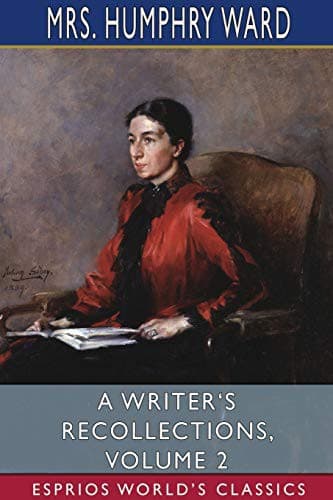
A Writer's Recollections — Volume 2Ward, Humphry, Mrs.
General
A Writer's Recollections — Volume 2
Ward, Humphry, Mrs.
Novelists, English -- 19th century -- Biography; Novelists, English -- 20th century -- Biography; Ward, Humphry, Mrs., 1851-1920
Mrs. Goschen, though full of kindness and goodness, was not literary,
and the house was somewhat devoid of books, except in Mr. Goschen's
study. I remember J.R.G.'s laughing fling when Mrs. Goschen complained
that she could not get _Pride and Prejudice_, which he had recommended
to her, "from the library." "But you could have bought it for sixpence
at the railway bookstall," said J.R.G. Mr. Goschen himself, however, was
a man of wide cultivation, as befitted the grandson of the intelligent
German bourgeois who had been the publisher of both Schiller and Goethe.
His biography of his grandfather in those happy days before the present
life-and-death struggle between England and Germany has now a kind of
symbolic value. It is a study by a man of German descent who had become
one of the most trusted of English statesmen, of that earlier German
life--with its measure, its kindness, its idealism--on which Germany has
turned its back. The writing of this book was the pleasure of his later
years, amid the heavy work which was imposed upon him as a Free-Trader,
in spite of his personal friendship for Mr. Chamberlain, by the Tariff
Reform campaign of 1903 onward; and the copy which he gave me reminds me
of many happy talks with him, and of my own true affection for him. I am
thankful that he did not live to see 1914.
Lord Goschen reminds me of Lord Acton, another new friend of the
'eighties. Yet Lord Acton had been my father's friend and editor, in the
_Home and Foreign Review_, long before he and I knew each other. Was
there ever a more interesting or a more enigmatic personality than Lord
Acton's? His letters to Mrs. Drew, addressed, evidently, in many cases,
to Mr. Gladstone, through his daughter, have always seemed to me one of
the most interesting documents of our time. Yet I felt sharply, in
reading them, that the real man was only partially there; and in the new
series of letters just published (October, 1917) much and welcome light
is shed upon the problem of Lord Acton's mind and character. The
perpetual attraction for me, as for many others, lay in the contrast
between Lord Acton's Catholicism and the universalism of his learning;
and, again, between what his death revealed of the fervor and simplicity
of his Catholic faith, and the passion of his Liberal creed.
Oppression--tyranny--persecution--those were the things that stirred
his blood. He was a Catholic, yet he fought Ultramontanism and the
Papal, Curia to the end; he never lost his full communion with the
Church of Rome, yet he could never forgive the Papacy for the things it
had done, and suffered to be done; and he would have nothing to do with
the excuse that the moral standards of one age are different from those
of another, and therefore the crimes of a Borgia weigh more lightly and
claim more indulgence than similar acts done in the nineteenth century.
Public-domain text, read in full here on John Shaqi.
Reviews
Reviews
No reviews yet
Be the first to share your thoughts on this work.
Join the Discussion
Join the discussion
Sign in to leave a comment or review.
Sign InorCreate an account