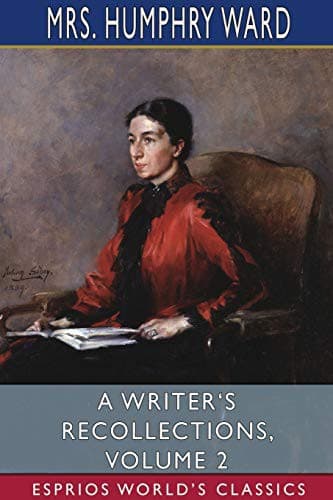
A Writer's Recollections — Volume 2Ward, Humphry, Mrs.
General
A Writer's Recollections — Volume 2
Ward, Humphry, Mrs.
Novelists, English -- 19th century -- Biography; Novelists, English -- 20th century -- Biography; Ward, Humphry, Mrs., 1851-1920
Here then, to begin with, were Robert and Catharine. Yes, but Robert
must be made intellectually intelligible. Closely looked at, all
novel-writing is a sort of shorthand. Even the most simple and broadly
human situation cannot really be told in full. Each reader in following
it unconsciously supplies a vast amount himself. A great deal of the
effect is owing to things quite out of the picture given--things in the
reader's own mind, first and foremost. The writer is playing on common
experience; and mere suggestion is often far more effective than
analysis. Take the paragraph in Turguénieff's _Lisa_--it was pointed out
to me by Henry James--where Lavretsky on the point of marriage, after
much suffering, with the innocent and noble girl whom he adores,
suddenly hears that his intolerable first wife, whom he had long
believed dead, is alive. Turguénieff, instead of setting out the
situation in detail, throws himself on the reader: "It was dark.
Lavretsky went into the garden, and walked up and down there till dawn."
That is all. And it is enough. The reader who is not capable of sharing
that night walk with Lavretsky, and entering into his thoughts, has read
the novel to no purpose. He would not understand, though Lavretsky or
his creator were to spend pages on explaining.
But in my case, what provoked the human and emotional crisis--what
produced the _story_--was an intellectual process. Now the difficulty
here in using suggestion--which is the master tool of the novelist--is
much greater than in the case of ordinary experience. For the conscious
use of the intellect on the accumulated data of life, through history
and philosophy, is not ordinary experience. In its more advanced forms,
it only applies to a small minority of the human race.
Still, in every generation, while a minority is making or taking part in
the intellectual process itself, there is an atmosphere, a diffusion,
produced around them, which affects many thousands who have but little
share--but little _conscious_ share, at any rate--in the actual process.
Here, then, is the opening for suggestion--in connection with the
various forms of imagination which enter into Literature; with poetry,
and fiction, which, as Goethe saw, is really a form of poetry. And a
quite legitimate opening. For to use it is to quicken the intellectual
process itself, and to induce a larger number of minds to take part
in it.
The problem, then, in intellectual poetry or fiction, is so to suggest
the argument, that both the expert and the popular consciousness may
feel its force, and to do this without overstepping the bounds of poetry
or fiction; without turning either into mere ratiocination, and so
losing the "simple, sensuous, passionate" element which is their
true life.
Public-domain text, read in full here on John Shaqi.
Reviews
Reviews
No reviews yet
Be the first to share your thoughts on this work.
Join the Discussion
Join the discussion
Sign in to leave a comment or review.
Sign InorCreate an account