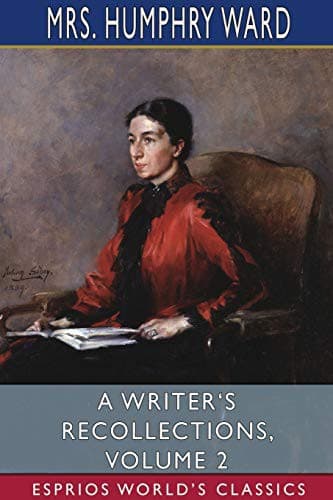
A Writer's Recollections — Volume 2Ward, Humphry, Mrs.
General
A Writer's Recollections — Volume 2
Ward, Humphry, Mrs.
Novelists, English -- 19th century -- Biography; Novelists, English -- 20th century -- Biography; Ward, Humphry, Mrs., 1851-1920
In my eyes Lord Morley's crowning achievement in literature is his
biography of Mr. Gladstone. How easy it would have been to smother Mr.
Gladstone in stale politics!--and how stale politics may become in that
intermediate stage before they pass finally into history! English
political literature is full of biography of this kind. The three
notable exceptions of recent years which occur to me are Mr. Churchill's
_Life_ of his father, the Disraeli biography still in progress, and the
_Gladstone_. But it would be difficult indeed to "stale" the story of
either Lord Randolph or Dizzy. A biographer would have to set about it
of malice prepense. In the case, however, of Mr. Gladstone, the danger
was more real. Anglican orthodoxy, eminent virtue, unfailing decorum; a
comparatively weak sense of humor, and a literary gift much inferior to
his oratorical gift, so that the most famous of his speeches are but
cold reading now; interminable sentences, and an unfailing relish for
detail all important in its day, but long since dead and buried; the
kind of biography that, with this material, half a dozen of Mr.
Gladstone's colleagues might have written of him, for all his greatness,
rises formidably on the inward eye. The younger generation waiting for
the historian to come--except in the case of those whose professional
duty as politicians it would have been to read it--might quite well have
yawned and passed by.
But Mr. Morley's literary instinct, which is the artistic instinct,
solved the problem. The most interesting half of the book will always, I
think, be the later half. In the great matters of his hero's earlier
career--Free Trade, the Crimean War, the early budgets, the slow
development of the Liberal leader from the Church and State Conservative
of 1832, down to the franchise battle of the 'sixties and the "great
Ministry," as Mr. Morley calls it, of 1868, the story is told, indeed,
perhaps here and there at too great length, yet with unfailing ease and
lucidity. The teller, however, is one who, till the late 'seventies, was
only a spectator, and, on the whole, from a distance, of what he is
describing, who was indeed most of the time pursuing his own special
aims--i.e., the hewing down of orthodoxy and tradition, together with
the preaching of a frank and uncompromising agnosticism, in the
_Fortnightly Review_; aims which were, of all others, most opposed to
Mr. Gladstone's. But with the 'eighties everything changes. Mr. Morley
becomes a great part of what he tells. During the intermediate
stage--marked by his editorship of the _Pall Mall Gazette_--the tone of
the biography grows sensibly warmer and more vivid, as the writer draws
nearer and nearer to the central scene; and with Mr. Morley's election
to Newcastle and his acceptance of the Chief-Secretaryship in 1885, the
book becomes the fascinating record of not one man, but two, and that
without any intrusion whatever on the rights of the main figure. The
Public-domain text, read in full here on John Shaqi.
Reviews
Reviews
No reviews yet
Be the first to share your thoughts on this work.
Join the Discussion
Join the discussion
Sign in to leave a comment or review.
Sign InorCreate an account