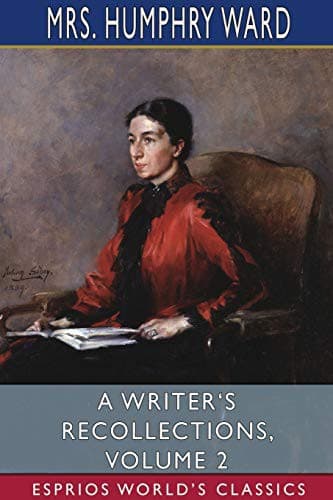
A Writer's Recollections — Volume 2Ward, Humphry, Mrs.
General
A Writer's Recollections — Volume 2
Ward, Humphry, Mrs.
Novelists, English -- 19th century -- Biography; Novelists, English -- 20th century -- Biography; Ward, Humphry, Mrs., 1851-1920
Nobody who knew the modest Cobham cottage while its master lived will
ever forget it; the garden beside the Mole, where every bush and
flower-bed had its history; and that little study-dressing-room where
some of the best work in nineteenth-century letters was done. Not a
great multitude of books, but all cherished, all read, each one the
friend of its owner. No untidiness anywhere; the ordinary litter of an
author's room was quite absent. For long after his death the room
remained just as he had left it, his coat hanging behind the door, his
slippers beside his chair, the last letters he had received, and all the
small and simple equipment of his writing-table ready to his hand,
waiting for the master who would never know "a day of return." In that
room--during fifteen years, he wrote _God and the Bible_, the many
suggestive and fruitful Essays, including the American addresses, of his
later years--seeds, almost all of them, dropped into the mind of his
generation for a future harvesting; a certain number of poems, including
the noble elegiac poem on Arthur Stanley's death, "Geist's Grave" and
"Poor Matthias"; a mass of writing on education which is only now,
helped by the war, beginning to tell on the English mind; and the
endlessly kind and gracious letters to all sorts and conditions of
men--and women--the literary beginner, the young teacher wanting advice,
even the stranger greedy for an autograph. Every little playful note to
friends or kinsfolk he ever wrote was dear to those who received it; but
he--the most fastidious of men--would have much disliked to see them all
printed at length in Mr. Russell's indiscriminate volumes. He talked to
me once of his wish to make a small volume--"such a little one!"--of
George Sand's best letters. And that is just what he would have wished
for himself.
Among the letters that reached me on my uncle's death was one from Mr.
Andrew Lang denouncing almost all the obituary notices of him. "Nobody
seems to know that he _was a poet_!" cries Mr. Lang. But his poetic
blossoming was really over with the 'sixties, and in the hubbub that
arose round his critical and religious work--his attempts to drive
"ideas" into the English mind, in the 'sixties and 'seventies--the main
fact that he, with Browning and Tennyson, _stood for English poetry_, in
the mid-nineteenth century, was often obscured and only slowly
recognized. But it was recognized, and he himself had never any real
doubt of it, from the moment when he sent the "Strayed Reveller" to my
father in New Zealand in 1849, to those later times when his growing
fame was in all men's ears. He writes to his sister in 1878:
It is curious how the public is beginning to take my poems to its
bosom after long years of comparative neglect. The wave of thought
and change has rolled on until people begin to find a significance
and an attraction in what had none for them formerly.
Public-domain text, read in full here on John Shaqi.
Reviews
Reviews
No reviews yet
Be the first to share your thoughts on this work.
Join the Discussion
Join the discussion
Sign in to leave a comment or review.
Sign InorCreate an account