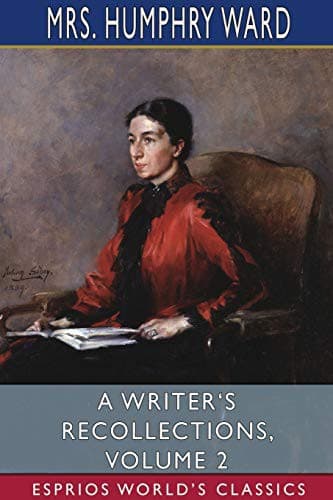
A Writer's Recollections — Volume 2Ward, Humphry, Mrs.
General
A Writer's Recollections — Volume 2
Ward, Humphry, Mrs.
Novelists, English -- 19th century -- Biography; Novelists, English -- 20th century -- Biography; Ward, Humphry, Mrs., 1851-1920
Exactly twenty years from the date of this letter I was in Toronto for
the first time, and paid my homage to the veteran fighter who, living as
he did amid a younger generation, hotly resenting his separatist and
anti-Imperial views and his contempt for their own ideal of an equal and
permanent union of free states under the British flag, was yet
generously honored throughout the Dominion for his services to
literature and education. He had been my father's friend at
Oxford--where he succeeded to Arthur Stanley's tutorship at University
College--and in Dublin. And when I first began to live in Oxford he was
still Regius Professor, inhabiting a house very near that of my parents,
which was well known to me afterward through many years as the house of
the Max Müllers. I can remember the catastrophe it seemed to all his
Oxford friends when he deserted England for America, despairing of the
republic, as my father for a while in his youth had despaired, and sick
of what seemed to him the forces of reaction in English life. I was
eighteen when _Endymion_ came out, with Dizzy's absurd attack on the
"sedentary" professor who was also a "social parasite." It would be
difficult to find two words in the English language more wholly and
ludicrously inappropriate to Goldwin Smith; and the furious letter to
the _Times_ in which he denounced "the stingless insults of a coward"
might well have been left unwritten. But I was living then among Oxford
Liberals, and under the shadow of Goldwin Smith's great reputation as
historian and pamphleteer, and I can see myself listening with an angry
and sympathetic thrill to my father as he read the letter aloud. Then
came the intervening years, in which one learned to look on Goldwin
Smith as _par excellence_ the great man "gone wrong," on that vital
question, above all, of a sane Imperialism. It was difficult, after a
time, to keep patience with the Englishman whose most passionate desire
seemed to be to break up the Empire, to incorporate Canada in the United
States, to relieve us of India, that "splendid curse," to detach from us
Australia and South Africa, and thereby to wreck forever that vision of
a banded commonwealth of free nations which for innumerable minds at
home was fast becoming the romance of English politics.
Public-domain text, read in full here on John Shaqi.
Reviews
Reviews
No reviews yet
Be the first to share your thoughts on this work.
Join the Discussion
Join the discussion
Sign in to leave a comment or review.
Sign InorCreate an account