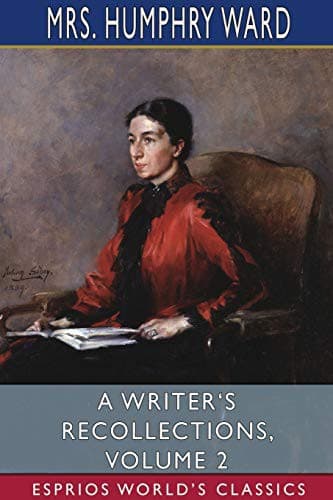
A Writer's Recollections — Volume 2Ward, Humphry, Mrs.
General
A Writer's Recollections — Volume 2
Ward, Humphry, Mrs.
Novelists, English -- 19th century -- Biography; Novelists, English -- 20th century -- Biography; Ward, Humphry, Mrs., 1851-1920
slackened the pace and chilled the atmosphere of the novel. After all,
what really supplied "the other side" was the whole system of things in
which the readers of the book lived and moved--the ideas in which they
had been brought up, the books they read, the churches in which they
worshiped, the sermons to which they listened every week. The novel
challenged this system of things; but it was always there to make reply.
It was the eternal _sous-entendu_ of the story, and really gave the
story all its force.
But in the dialogue I could put the underlying conflict of thought into
articulate and logical form, and build up, in outline at least, the
history of "a new learning." When it was published, the dear Master,
with a sigh of relief, confessed that it had "done no harm," and "showed
a considerable knowledge of critical theology." I, too, felt that it had
done no harm--rather that it had vindicated my right to speak, not as an
expert and scholar--to that I never pretended for a moment--but as the
interpreter of experts and scholars who had something to say to the
English world, and of whom the English world was far too little aware.
In the preface to one of the latest editions of his Bampton Lectures,
Canon Liddon wrote an elaborate answer to it, which, I think, implies
that it was felt to have weight; and if Lord Acton had waited for its
appearance he might not, perhaps, have been so ready to condemn the
character of Newcome as belonging "to the infancy of art." That
Newcome's type might have been infinitely better presented is indeed
most true. But in the scheme of the book, it is _right_. For the
ultimate answer to the critical intellect, or, as Newman called it, the
"wild living intellect of man," when it is dealing with Christianity and
miracle, is that reason is _not_ the final judge--is, indeed, in the
last resort, the enemy, and must at some point go down, defeated and
trampled on. "Ideal Ward," and Archdeacon Denison, and Mr. Spurgeon--and
not Doctor Figgis or Doctor Creighton--are the apologists who in the end
hold the fort.
Public-domain text, read in full here on John Shaqi.
Reviews
Reviews
No reviews yet
Be the first to share your thoughts on this work.
Join the Discussion
Join the discussion
Sign in to leave a comment or review.
Sign InorCreate an account