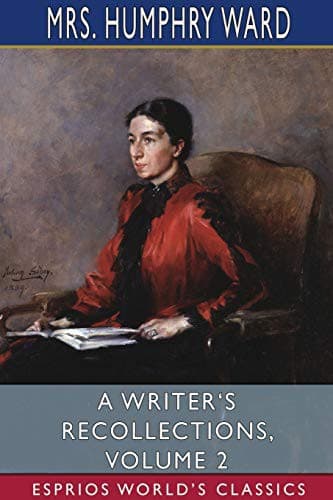
A Writer's Recollections — Volume 2Ward, Humphry, Mrs.
General
A Writer's Recollections — Volume 2
Ward, Humphry, Mrs.
Novelists, English -- 19th century -- Biography; Novelists, English -- 20th century -- Biography; Ward, Humphry, Mrs., 1851-1920
A visit to Derbyshire in the autumn gave me some of the setting for the
story. Then I took the first chapters abroad during the winter to
Valescure, and worked them in that fragrant, sunny spot, making
acquaintance the while with a new and delightful friend, Emily Lawless,
the author of _Hurrish_ and _Grania_, and of some few poems that
deserve, I think, a long life in English anthologies. She and her most
racy, most entertaining mother, old Lady Cloncurry, were spending the
winter at Valescure, and my young daughter and I found them a great
resource. Lady Cloncurry, who was a member of an old Galway family, the
Kirwans of Castle Hackett, seemed to me a typical specimen of those
Anglo-Irish gentry who have been harshly called the "English garrison"
in Ireland, but who were really in the last century the most natural and
kindly link between the two countries. So far as I knew them, they loved
both, with a strong preference for Ireland. All that English people
instinctively resent in Irish character--its dreamy or laughing
indifference toward the ordinary business virtues, thrift, prudence,
tidiness, accuracy--they had been accustomed to, even where they had not
been infected with it, from their childhood. They were not Catholics,
most of them, and, so far as they were landlords, the part played by the
priests in the Land League agitation tried them sore. But Miss Lawless's
_Grania_ is there to show how delicate and profound might be their
sympathy with the lovely things in Irish Catholicism, and her best
poems--"The Dirge of the Munster Forest" and "After Aughrim"--give a
voice to Irish suffering and Irish patriotism which it would be hard to
parallel in the Nationalist or rebel literature of recent years. The
fact that they had both nations in their blood, both patriotisms in
their hearts, infused a peculiar pathos often into their lives.
Pathos, however, was not a word that seemed--at first sight, at any
rate--to have much to do with Lady Cloncurry. She was the most energetic
and sprightly _grande dame_ as I remember her, small, with vivid black
eyes and hair, her head always swathed in a becoming black lace coif,
her hands in black mittens. She and her daughter Emily amused each other
perennially, and were endless good company, besides, for other people.
Lady Cloncurry's clothes varied very little. She had an Irish contempt
for too much pains about your appearance, and a great dislike for
_grande tenue_. When she arrived at an Irish country-house, of which the
hostess told me the story, she said to the mistress of the house, on
being taken to her room: "My dear, you don't want me to come down smart?
I'm sure you don't! Of course I've brought some smart gowns. _They_
[meaning her daughters] make me buy them. But they'll just do for my
maid to show your maid!" And there on the wardrobe shelves they lay
throughout her visit.
Public-domain text, read in full here on John Shaqi.
Reviews
Reviews
No reviews yet
Be the first to share your thoughts on this work.
Join the Discussion
Join the discussion
Sign in to leave a comment or review.
Sign InorCreate an account