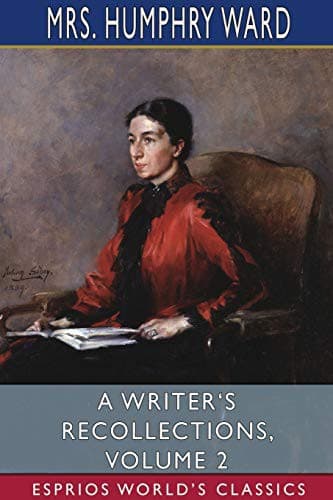
A Writer's Recollections — Volume 2Ward, Humphry, Mrs.
General
A Writer's Recollections — Volume 2
Ward, Humphry, Mrs.
Novelists, English -- 19th century -- Biography; Novelists, English -- 20th century -- Biography; Ward, Humphry, Mrs., 1851-1920
Twenty years! How clearly one sees the mistakes, the lost opportunities,
of such an enterprise! But so much is certain--that the Settlement has
been an element of happiness in many, many lives. It has had scores of
devoted workers, in the past--men and women to whom the heart of its
founder goes out in gratitude. And I cannot imagine a time when the
spacious and beautiful house and garden, with all the activities that
have a home there, will not be necessary and welcome to St. Pancras. I
see it, in my dreams, at least, half a century hence, when all those who
first learned from it and in it have gone their way, still serving "the
future hour" of an England reborn. To two especially among the early
friends of the Settlement let me turn back with grateful
remembrance--George Howard, Lord Carlisle, whom I have already
mentioned, and Stopford Brooke. Lord Carlisle was one of the most
liberal and most modest of men, an artist himself, and the friend of
artists. On a Sunday in Russell Square, when the drawing-room door
opened to reveal his fine head and shy, kind eyes, one felt how well
worth while it was to stay at home on Sunday afternoons! I find a little
note from him in 1891, the year in which we left Russell Square to move
westward, regretting the "interesting old house" "with which I associate
you in my mind." He was not an easy talker, but his listening had the
quality that makes others talk their best; while the sudden play of
humor or sarcasm through the features that were no less strong than
refined, and the impression throughout of a singularly upright and
humane personality, made him a delightful companion. There were those
who would gladly have seen him take a more prominent part in public
life. Perhaps a certain natural indolence held him back; perhaps a
wonderful fairness of mind which made him slow to judge, and abnormally
sensitive to "the other side." It is well known that as a landlord he
left the administration of his great estates in the north almost wholly
to his wife, and that, except in the great matter of temperance, he and
she differed in politics, Lady Carlisle--who was a Stanley of
Alderley--going with Mr. Gladstone at the time of the Home Rule split,
while Lord Carlisle joined the Liberal Unionists. Both took a public
part, and the political differences of the parents were continued in
their children. Only a very rare and selfless nature could have carried
through so difficult a situation without lack of either dignity or
sweetness. Lord Carlisle, in the late 'eighties and early 'nineties,
when I knew him best, showed no want of either. The restrictions he laid
upon his own life were perhaps made natural by the fact that he was
first and foremost an artist by training and temperament, and that the
ordinary occupations, rural, social, or political, of the great
land-owning noble, had little or no attraction for him. In the years, at
any rate, when I saw him often, I was drawn to him by our common
Public-domain text, read in full here on John Shaqi.
Reviews
Reviews
No reviews yet
Be the first to share your thoughts on this work.
Elsewhere in the archive
Join the Discussion
Join the discussion
Sign in to leave a comment or review.
Sign InorCreate an account