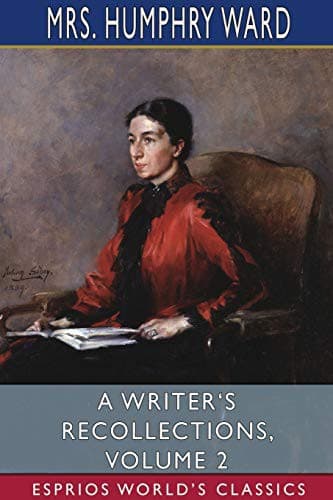
A Writer's Recollections — Volume 2Ward, Humphry, Mrs.
General
A Writer's Recollections — Volume 2
Ward, Humphry, Mrs.
Novelists, English -- 19th century -- Biography; Novelists, English -- 20th century -- Biography; Ward, Humphry, Mrs., 1851-1920
interest in the liberalizing of religion, and by a common love of Italy
and Italian art. I remember him once in the incomparable setting of
Naworth; but more often in London, and in Stopford Brooke's company.
For he was an intimate friend and follower of Mr. Brooke's, and I came
very early under the spell of that same strong and magnetic personality.
While we were still at Oxford, through J.R.G. we made acquaintance with
Mr. Brooke, and with the wife whose early death in 1879 left desolate
one of the most affectionate of men. I remember well Mr. Brooke's last
sermon in the University pulpit, before his secession, on grounds of
what we should now call Modernism, from the Church of England. Mrs.
Brooke, I think, was staying with us, while Mr. Brooke was at All Souls,
and the strong individuality of both the husband and wife made a deep
impression upon one who was then much more responsive and recipient than
individual. The sermon was a great success; but it was almost Mr.
Brooke's latest utterance within the Anglican Church. The following year
came the news of Mrs. Brooke's mortal illness. During our short meeting
in 1877 I had been greatly attracted by her, and the news filled me with
unbearable pain. But I had not understood from it that the end itself
was near, and I went out into our little garden, which was a mass of
summer roses, and in a bewilderment of feeling gathered all I could
find--a glorious medley of bloom--that they might surround her, if only
for a day, with the beauty she loved. Next day, or the day after, she
died; and that basket of roses, arriving in the house of death--belated,
incongruous offering!--has stayed with me as the symbol of so much else
that is too late in life, and of our human helplessness and futility in
the face of sorrow.
After our move to London, my children and I went for a long time
regularly to hear Mr. Brooke at Bedford Chapel. At the time, I often
felt very critical of the sermons. Looking back, I cannot bring myself
to say a critical word. If only one could still go and hear him! Where
are the same gifts, the same magnetism, the same compelling personality
to be found to-day, among religious leaders? I remember a sermon on
Elijah and the priests of Baal, which for color and range, for
modernness, combined with ethical force and power, remains with me as
perhaps the best I ever heard. And then, the service. Prayers
simplified, repetitions omitted, the Beatitudes instead of the
Commandments, a dozen jarring, intolerable things left out; but for the
rest, no needless break with association. And the relief and consolation
of it! The simple Communion service, adapted very slightly from the
Anglican rite, and administered by Mr. Brooke with a reverence, an
ardor, a tenderness one can only think of with emotion, was an example
of what _could_ be done with our religious traditions, for those who
want new bottles for new wine, if only the courage and the imagination
were there.
Public-domain text, read in full here on John Shaqi.
Reviews
Reviews
No reviews yet
Be the first to share your thoughts on this work.
Elsewhere in the archive
Join the Discussion
Join the discussion
Sign in to leave a comment or review.
Sign InorCreate an account