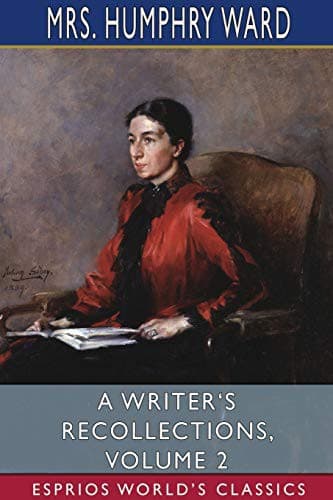
A Writer's Recollections — Volume 2Ward, Humphry, Mrs.
General
A Writer's Recollections — Volume 2
Ward, Humphry, Mrs.
Novelists, English -- 19th century -- Biography; Novelists, English -- 20th century -- Biography; Ward, Humphry, Mrs., 1851-1920
The autumn of 1896 brought me a great loss in the death of an intimate
friend, Lady Wemyss--as marked a personality in her own circle as was
her indomitable husband, the famous Lord Elcho, of the Volunteer
movement, on the bigger stage. It was at Balliol, at the Master's table,
and in the early Oxford days, that we first made friends with Lord and
Lady Wemyss, who were staying with the Master for the Sunday. I was
sitting next to Lord Wemyss, and he presently discovered that I was
absent-minded. And I found him so attractive and so human that I soon
told him why. I had left a sick child at home, with a high temperature,
and was fidgeting to get back to him.
"What is the matter?--Fever?--throat? Aconite, of course! You're a
homeopath, aren't you? All sensible people are. Look here--I've got a
servant with me. I'll send him with some aconite at once. Where do you
live?--in the Parks? All right. Give me your address."
Out came an envelope and a pencil. A message was sent round the
dinner-table to Lady Wemyss, whose powerful dreaming face beside the
Master lit up at once. The aconite was sent; the child's temperature
went down; and, if I remember right, either one or both of his new
medical advisers walked up to the Parks the next day to inquire for him.
So began a friendship which for just twenty years, especially from about
1885 to 1896, meant a great deal to me.
How shall I describe Lady Wemyss? An unfriendly critic has recently
allowed me the power of "interesting fashionable ladies in things of the
mind." Was Lady Wemyss a "fashionable lady"? She was the wife,
certainly, of a man of high rank and great possessions; but I met her
first as a friend--a dear and intimate friend, as may be seen from his
correspondence--of Mr. Jowett's; and Mr. Jowett was not very tolerant of
"fashionable ladies." She was in reality a strong and very simple
person, with a natural charm working through a very reserved and often
harsh manner, like the charm of mountain places in spring. She was a
Conservative, and I suppose an aristocrat, whatever that word may mean.
She thought the Harcourt death-duties "terrible" because they broke up
old families and old estates, and she had been brought up to think that
both were useful. Yet I never knew anybody with a more instinctive
passion for equality. This means that she was simply and deeply
interested in all sorts of human beings and all sorts of human lots;
also that, although she was often self-conscious, it was the
self-consciousness one sees in the thoughtful and richly natured young,
whose growth in thought or character has outrun their means of
expression, and never mean or egotistical. Her deep voice; her fine,
marked features; and the sudden play of humor, silent, self-restrained,
yet most infectious to the bystander, that would lighten through them;
her stately ways; and yet, withal, her childlike love of loving and
being loved by the few to whom she gave her deepest affection--in some
Public-domain text, read in full here on John Shaqi.
Reviews
Reviews
No reviews yet
Be the first to share your thoughts on this work.
Elsewhere in the archive
Join the Discussion
Join the discussion
Sign in to leave a comment or review.
Sign InorCreate an account