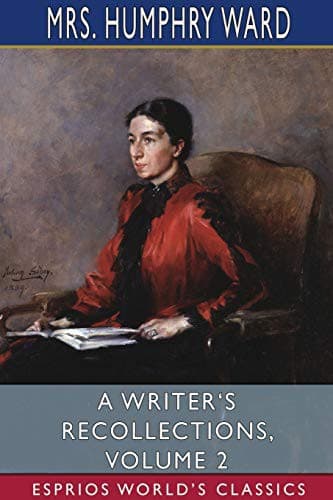
A Writer's Recollections — Volume 2Ward, Humphry, Mrs.
General
A Writer's Recollections — Volume 2
Ward, Humphry, Mrs.
Novelists, English -- 19th century -- Biography; Novelists, English -- 20th century -- Biography; Ward, Humphry, Mrs., 1851-1920
such phrases one tries to describe her; but they go a very little way.
I can see her now at the dinner-table at Gosford, sardonically watching
a real "fashionable lady" who had arrived in the afternoon and was
sitting next Lord Wemyss at the farther end--with a wonderful frizzled
head, an infinitesimal waist sheathed in white muslin and blue ribbons,
rouged cheeks, a marvelous concatenation of jewels, and a caressing,
gesticulating manner meant, at fifty, to suggest the ways of "sweet and
twenty." The frizzled head drew nearer and nearer to Lord Wemyss, the
fingers flourished and pointed; and suddenly I heard Lady Wemyss's deep
voice, meditatively amused, beside me:
"Her fingers will be in Frank's eyes soon!" Or again, I see her, stalled
beneath the drawing-room table, on all-fours, by her imperious
grandchildren, patiently playing "horse" or "cow," till her scandalized
daughter-in-law discovered her and ran to her release. Or in her last
illness, turning her noble head and faint, welcoming smile to the few
friends that were admitted; and finally, in the splendid rest after
death, when those of us who had not known her in youth could guess what
the beauty of her youth had been.
She was an omnivorous and most intelligent reader, and a friend that
never failed. Matthew Arnold was very fond of her, and she of him; Laura
Lyttelton, who was nearly forty years her junior, loved her dearly and
never felt the bar of years; the Master owed much to her affection, and
gratefully acknowledged it. The _Commonplace Book_, privately printed
after her death, showed the range of interests which had played upon her
fresh and energetic mind. It was untrained, I suppose, compared to the
woman graduate of to-day. But it was far less tired; and all its
adventures were of its own seeking.
It was in 1896, not long after the appearance of _George Tressady_, that
a conversation in a house on the outskirts of the Lakes suggested to me
the main plot of _Helbeck of Bannisdale._ The talk turned on the
fortunes of that interesting old place, Sizergh Castle, near Kendal, and
of the Catholic family to whom it then still belonged, though mortgages
and lack of pence were threatening imminently to submerge an ancient
stock that had held it unbrokenly, from father to son, through many
generations.
The relation between such a family--pinched and obscure, yet with its
own proud record, and inherited consciousness of an unbroken loyalty to
a once persecuted faith--and this modern world of ours struck me as an
admirable subject for a novel. I thought about it next day, all through
a long railway journey from Kendal to London, and by the time I reached
Euston the plot of _Helbeck of Bannisdale_ was more or less clear to me.
Public-domain text, read in full here on John Shaqi.
Reviews
Reviews
No reviews yet
Be the first to share your thoughts on this work.
Elsewhere in the archive
Join the Discussion
Join the discussion
Sign in to leave a comment or review.
Sign InorCreate an account