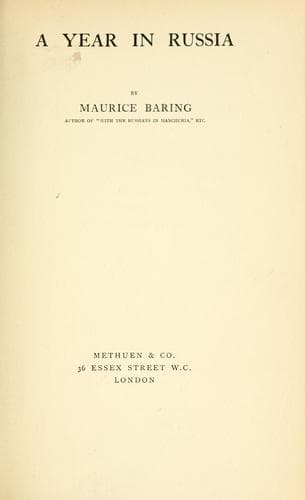
Russia -- History -- Revolution, 1905-1907; Russia -- Politics and government -- 1894-1917; Russia -- Social conditions -- 1801-1917
If the British Cabinet were to circulate among the Army an invitation to
destroy the House of Commons, full of insulting strictures on the
members of the House, we should not consider this action to be
constitutional. But this is what the Russian Government has been doing
during the last month. The situation of a Parliament which has to deal
with such a Ministry is abnormal. What guarantee is there that the
Ministry will not dissolve it at any minute and change the electoral
law? Not, certainly, the fact that this would be illegal and
unconstitutional. Therefore, on these grounds, and in these
circumstances, it seems to me that the action of the members of the
Duma, in insisting on having their “say out” on the land question before
anything else happens, is not so needless and not such a waste of time
as it at first appears to be. The speeches of the members are reported
in full, published in the newspapers, and read all over the country, and
therefore if the Duma is dissolved suddenly the country will be already
acquainted with the opinions and intentions of the Duma on the land
question. This is why the fact that the Duma has existed and spoken out
during a month is in itself one of paramount importance and likely to be
big with far-reaching results. When the Duma met the Russian people
echoed the French poet’s cry that “une grande espérance a traversé le
monde,” but they were doubtful as to its efficacy. Now that it has met
during a whole month, and that people within its walls have really been
able to speak their minds on burning topics without being arrested, and
have in no uncertain tones expressed their opinion of the present
Government, the effect has been enormous.
Last night I was driven home by a cabman who favoured me with his
political views. I attach far more importance to the views of any cabman
in St. Petersburg than to those of any of the Ministers, because they
are more intimately acquainted with popular opinion. The cabman first
expressed his appreciation of the fact that some people in Russia had
too much land and others too little. Count Ignatieff’s estate, he said,
was a hundred versts long, and he had eight estates. The Duma, he
continued, was demanding land and liberty. I objected that the Duma
might be dissolved. “They won’t dare,” he replied. “But if they do
dare?” I said. “Then we shall kill them,” he answered. “Kill whom?”
“Why, all the rich.” “But will the soldiers be on your side?” I asked.
“The soldiers are peasants, too,” he said. “But before they shot at the
people,” I said. “Before they did not understand what it was all about.
Now they know,” he said. “Go into any _tractir_ (public-house) you
like,” he continued, “and you will hear how the people are screaming.”
Public-domain text, read in full here on John Shaqi.
Reviews
Reviews
No reviews yet
Be the first to share your thoughts on this work.
Elsewhere in the archive
Join the Discussion
Join the discussion
Sign in to leave a comment or review.
Sign InorCreate an account