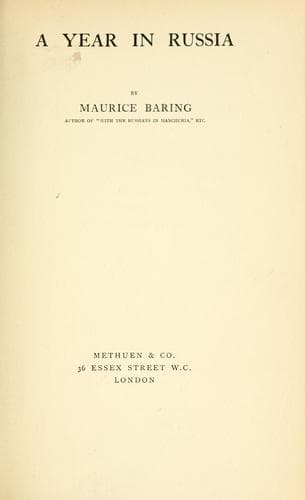
Russia -- History -- Revolution, 1905-1907; Russia -- Politics and government -- 1894-1917; Russia -- Social conditions -- 1801-1917
I asked him if he liked Tolstoi’s books. “Yes,” he answered. “His books
are great, but his philosophy is weak. It may be all right for mankind
thousands of years hence, but it is no use now. I have no friends,” he
continued. “Books are my friends. But lately my house was burnt, and all
my books with it. I have read a lot, but I never had anybody to tell me
what to read, so I read without any system. I did not go to school till
I was thirteen.”
“Do you like Dostoievski’s books?” “Yes; he knows all about the human
soul. When I see a man going down hill I know exactly how it will happen
and what he is going through, and I could stop him because I have read
Dostoievski.” “Have you read translations of any foreign books?” “Very
few; some of Zola’s books, but I don’t like them because he does not
really know the life he is describing. Some of Guy de Maupassant’s
stories I have read, but I do not like them either, because I don’t want
to know more about that sort of people than I know already.” “Have you
read Shakespeare?” “Yes. There is nobody like him. When you read a
conversation of Shakespeare’s, when one person is speaking you think he
is right, and when the next person answers him you think he is right. He
understands everybody. But I want to read Spencer—Herbert Spencer. I
have never been able to get his works.” I promised to procure him
Herbert Spencer’s works.
I hope he will go to London, for he is a strangely picturesque figure
and an original character, this dark-eyed Velasquez-like Nazarenko,
proud as Lucifer and full of ideals, a kind of mixture of Shelley and
Cato.
_July 7th._
This afternoon I went to have tea with two of the peasant deputies. They
had asked me because it was the Name-day of one of them. They are living
in a new hotel and are most comfortably lodged. They pay a rouble a day
for a room. Their rooms are far more comfortable and much cleaner than
mine. We had beer, vodka, cucumbers, sardines and cold sausage, and we
discussed very many subjects. During the afternoon many other members
dropped in, and among them a member of the “Council of Empire.” These
peasants, who come from an exceedingly distant government, belong to the
more educated category. I believe the education in their particular
government is good owing to the energy the Zemstva have displayed there.
There are three of these peasants: one of them is a sensible man who
does not know much about things outside Russia; but one of the others is
quite well acquainted with the main features of European politics and
talks of Jaurés, Chamberlain, and Lord Rosebery. “Who would have thought
two years ago,” said one of them, “that we should see an Englishman here
in the flesh?”
_July 8th._
Public-domain text, read in full here on John Shaqi.
Reviews
Reviews
No reviews yet
Be the first to share your thoughts on this work.
Elsewhere in the archive
Join the Discussion
Join the discussion
Sign in to leave a comment or review.
Sign InorCreate an account