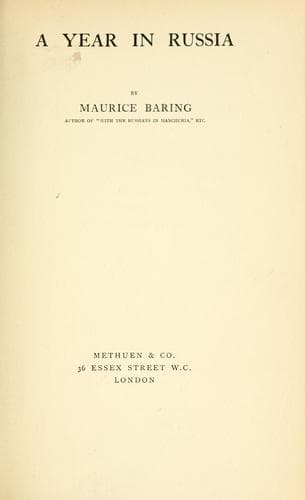
Russia -- History -- Revolution, 1905-1907; Russia -- Politics and government -- 1894-1917; Russia -- Social conditions -- 1801-1917
Again, take the land question: the demands on the Duma seem far less
exaggerated to a Russian Conservative than they do to an English Whig.
The Russian Conservative may, and probably does, disagree with them, but
he does not consider them childishly outrageous. The Duma contains some
highly-respected and important landlords, who have all voted in favour
of the principle of compulsory expropriation, and I think they know more
about the land question in Russia even than the most sensible
Englishman.
_July 6th_ (_Later_).
To-day in the Duma there was a barefooted man in rags, who said he had
arrived in St. Petersburg chiefly owing to the kindness of the railway
guards. His house had been burnt, owing to some squabble with the police
authorities. Another correspondent and I had some talk with him. He
thought we were deputies. He said: “Stand up for our rights and I will
go back and tell them you are doing so.”
_July 6th._
The question of the Inter-Parliamentary Congress to be held in London is
arousing interest here. It is not yet decided what delegates are to go.
Professor Kovolievski introduced me to one of the peasant members of the
Duma—Nazarenko, the deputy for Kharhov—who wished to speak to me about
it. Nazarenko is far the most remarkable of the peasant deputies. He is
a tall, striking figure, with black hair, a pale face with prominent
clearly-cut features, such as Velasquez would have taken to paint a
militant apostle. He went through the course of primary education, and
by subsequently educating himself he has attained to an unwonted degree
of culture. Besides this he is a born speaker and a most original
character. “I want to go to London,” he said, “so that the English may
see a real peasant and not a sham one, and so that I can tell the
English what we, the real people, think and feel about them.” I said I
was glad he was going. “I shan’t go unless I am chosen by the others,”
he answered. “I have written my name down and asked, but I shan’t ask
twice. I never ask twice for anything. When I say my prayers I only ask
God once for a thing, and if it is not granted I never ask again. So
it’s not likely I would ask my fellow-men twice for anything. I am like
that; I leave out that passage in the prayers about being a miserable
slave. I am not a miserable slave, neither of man nor of heaven.” “That
is what the Church calls spiritual pride,” I answered. “I don’t believe
in all that,” he answered. “My religion is the same as that of Tolstoi.”
He then pointed to the ikon which is in the lobby of the Duma. “I pay no
attention to that,” he said, “It is a board covered with gilt, but a lot
of people think that the ikon is God.”
Public-domain text, read in full here on John Shaqi.
Reviews
Reviews
No reviews yet
Be the first to share your thoughts on this work.
Elsewhere in the archive
Join the Discussion
Join the discussion
Sign in to leave a comment or review.
Sign InorCreate an account