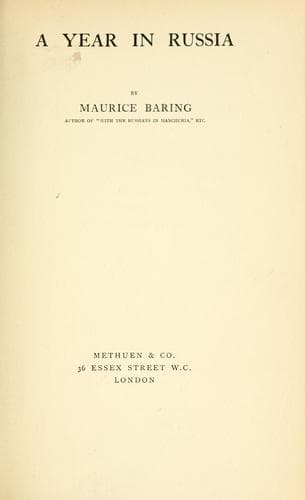
Russia -- History -- Revolution, 1905-1907; Russia -- Politics and government -- 1894-1917; Russia -- Social conditions -- 1801-1917
Near the house where I am living there is a village; as this village is
so close to the town of Moscow I thought that its inhabitants would be
suburban, and therefore not representative of peasant life. This is not
so. The nearness to Moscow seems to make no difference at all. I was
walking through the village on Saturday morning when a peasant who was
sitting on his doorstep called me and asked me if I would like to eat an
apple. I accepted his invitation. He said he presumed I was living with
X., as other Englishmen had lived there before. Then he asked abruptly,
“Is Marie Alexandrovna in your place?” I said my hostess’s name was
Marie Karlovna. “Of course,” he said, “I don’t mean here, but in your
place, in your country.” I didn’t understand. Then he said it again very
loud, and asked if I was deaf. I said I wasn’t deaf and that I
understood what he said, but I did not know to whom he was alluding.
“Talking to you,” he said, “is like talking to a Tartar. You look at one
and don’t understand what one says.” Then it suddenly flashed on me that
he was alluding to the Queen of England. “You mean Queen Alexandra,” I
said, “the sister of the Empress Marie Feodorovna.” “That’s what I
mean,” he said. It afterwards appeared that he considered that England
had been semi-Russianised owing to this relationship; he thought of
course that both the Queen and the Empress were Russians.
Two more peasants joined us, and one of them brought a small bottle (the
size of a sample) of vodka and a plate of cherries. “We will go and
drink this in the orchard,” they said. So we went to the orchard. “You
have come here to learn,” said the first peasant, a bearded man, whose
name was Feodor. “Many Englishmen have been here to learn. I taught one
all the words that we use.” I said I was a correspondent; that I had
just arrived from St. Petersburg, where I had attended the sittings of
the Duma. “What about the Duma?” asked the other peasant. “They’ve sent
it away. Will there be another one?” I said a manifesto spoke of a new
one. “Yes,” said Feodor, “there is a manifesto abolishing punishments.”
I said I hadn’t observed that clause. “Will they give us back our land?”
asked Feodor. “All the land here belongs to us really.” Then followed a
long explanation as to why the land belonged to them. It is the
property, as a matter of fact, of the Crown. I said I did not know. “If
they don’t give it back to us we shall take it,” he said simply. Then
one of the other peasants added, “Those manifestoes are not written by
the Emperor but by the ‘authorities.’” (The same thing was said to me by
a cabman at St. Petersburg, his reason being that the Emperor would say
“I,” whereas the manifesto said “We.”) Then they asked me why they had
not won the war; and whether it was true that the war had been badly
managed. “We know nothing,” he said. “What newspaper tells the truth?
Where can we find the real truth? Is it to be found in the _Russkoe
Slovo_?” (a big Moscow newspaper).
Public-domain text, read in full here on John Shaqi.
Reviews
Reviews
No reviews yet
Be the first to share your thoughts on this work.
Elsewhere in the archive
Join the Discussion
Join the discussion
Sign in to leave a comment or review.
Sign InorCreate an account