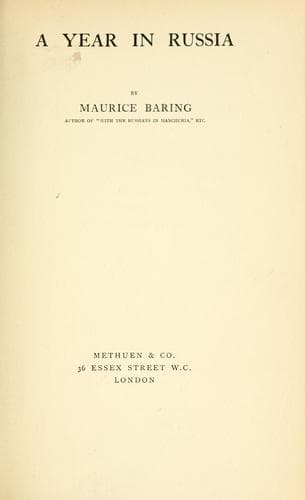
Russia -- History -- Revolution, 1905-1907; Russia -- Politics and government -- 1894-1917; Russia -- Social conditions -- 1801-1917
“I believe in God,” answered the tradesman, “but it is written in the
Scripture that God said: ‘Take the earth and cultivate it,’ and that is
what we have got to do; to make the best of this earth. When we die we
shall go to Heaven, and then”—he spoke in a practical tone of voice
which settled the matter—“then we shall have to do with God.” The priest
took out his Bible and found a passage in the Gospel. “This
revolutionary movement will go on,” he said, “nothing can stop it now;
but, mark my words, we shall see oceans of blood shed first, and this
prophecy will come true,” and he read the text about one stone not being
left on another.
Then they discussed the priesthood and the part played by priests. “The
priests play an abominable part,” said the tradesman; “they are worse
than murderers. A murderer is a man who goes and kills some one. He is
not so bad as the man who stays at home and tells others to kill. That
is what the priests do.” He then mentioned a monk who had preached
against the Jews in the South of Russia. “I call that man the greatest
criminal, because he stirred up the peasants’ blood, and they went to
kill the Jews. Lots of peasants cease to go to church and say their
prayers at home because of this. When the Cossacks come to beat them,
the priests tell them that they are sent by God. Do you believe they are
sent by God?” he asked, turning to the bearded peasant.
“No,” answered the peasant; “I think they are sent by the devil.” The
priest said that the universal dominion of the Jews was at hand. The
tradesman contested this, and said that in Russia the Jews assimilated
themselves to the people more than in other countries. “The Jews are
cunning,” said the priest; “the Russians are in a ditch, and they go to
the Jews and say: ‘Pull us out.’” “If that is true,” said the tradesman,
“we ought to put up a gold statue to the Jews for pulling us out of the
ditch. Look at the time of the _pogroms_, the rich Russians ran away,
but the richest Jews stayed behind.” “They are clever; they knew their
business. If they stayed you may be sure they gained something by it,”
said the merchant from Kursk. “But we ought to be clever, too,” said the
tradesman, “and try and imitate their self-sacrifice. Look at the Duma.
There were twenty Jews in the Duma, but they did not bring forward the
question of equal rights for the Jews before anything else as they might
have done. It is criminal for the priests to attack the Jews, and if
they go on like this the people will leave them.”
“Whereas,” said the merchant from Kursk thoughtfully, “if they supported
the people the people would never desert them.” “The priests,” said one
of the other nondescript people, “say that Catherine the Second is a
goddess; and for that reason her descendants have a hundred thousand
acres. General Trepoff will be canonised when he dies, and his bones
will work miracles.”
Public-domain text, read in full here on John Shaqi.
Reviews
Reviews
No reviews yet
Be the first to share your thoughts on this work.
Elsewhere in the archive
Join the Discussion
Join the discussion
Sign in to leave a comment or review.
Sign InorCreate an account