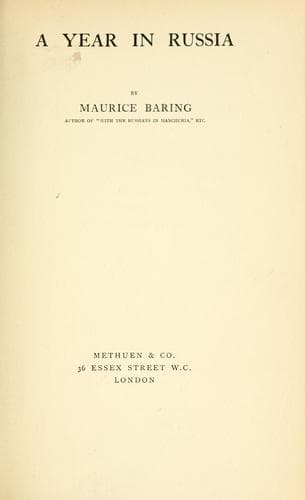
Russia -- History -- Revolution, 1905-1907; Russia -- Politics and government -- 1894-1917; Russia -- Social conditions -- 1801-1917
They began to talk politics. The Cossack was asked his opinion on the
attitude of the Cossacks. He said their attitude had changed, and that
they objected to police service. The photographer from Tchelabinsk
corroborated this statement, saying he had been present at a Cossack
meeting in Siberia. Then we had a short concert. The photographer
produced a mandoline and played tunes. All the inmates of the carriage
gathered round him. One of the peasants said: “Although I am an ignorant
man” (it was the peasant who had grunted) “I could see at once that he
wasn’t simply playing with his fingers, but with something else” (the
tortoiseshell that twangs the mandoline). He asked the photographer how
much a mandoline cost. On being told thirty roubles he said he would
give thirty roubles to be able to play as well as that. Somebody, by way
of appreciation, put a cigarette into the mouth of the photographer as
he was playing.
Then I went to bed in the next compartment; but not to sleep, because a
carpenter, who had the bed opposite mine, told me the whole story of his
life which was extremely melancholy. The volunteer appeared later; he
had been educated in the Cadet-Corps, and I asked him if he would soon
be an officer. “I will never be an officer,” he answered; “I don’t want
to be one _now_.” I asked him if a statement I had read in the
newspapers was true to the effect that several officers had telegraphed
to the Government that unless they were relieved of police duty they
would resign. He said it was quite true; that general discontent
prevailed among officers; that the life was getting unbearable; that
they were looked down upon by the rest of the people, and besides this
they were ordered about from one place to another. He liked the officers
whom he was with very much, but they were sick of the whole thing. Then
towards one in the morning I got a little sleep. As soon as it was
daylight everybody was up, making tea and busily discussing politics.
The priest and the tradesman were having a discussion about the Duma,
and every one else, including the guard, was joining in.
“Do you understand what the Duma was?” said the tradesman; “the Duma was
simply the people. Do you know what all that talk of a movement of
liberation means? It means simply this: that we want control,
responsibility. That if you are to get or to pay five roubles or fifty
roubles you will get or pay five roubles or fifty roubles, not more and
not less, and that nobody will have the right to interfere; and that if
some one interferes he will be responsible. The first thing the Duma
asked for was a responsible Ministry, and the reason why it was
dissolved is that the Government would not give that.”
The priest said that he approved of a Duma, but unless men changed
themselves no change of government was of any use. “Man must change
inwardly,” he said.
Public-domain text, read in full here on John Shaqi.
Reviews
Reviews
No reviews yet
Be the first to share your thoughts on this work.
Elsewhere in the archive
Join the Discussion
Join the discussion
Sign in to leave a comment or review.
Sign InorCreate an account