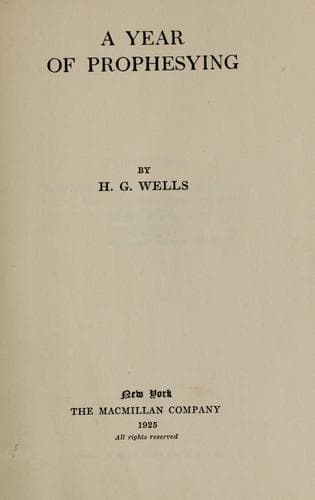
A year of prophesyingWells, H. G. (Herbert George)
History
A year of prophesying
Wells, H. G. (Herbert George)
Civilization, Modern -- 20th century; Europe -- History -- 20th century; Great Britain -- History -- 20th century
To a certain small extent this may be due to a rebellion of ordinary
common-sense people against the absurdity of committees doing one-man
jobs. In America the disposition to give great powers to mayors and
prominent public servants--a disposition which Mr. Belloc calls,
absurdly enough, a disposition to “monarchy,” and makes out to be a
fundamental difference between Americans and Europeans--is probably
due mainly to the perception of the need for a single head and a free
hand in many complicated jobs. But the job is defined, and the term of
power is defined. That concentration of _ad hoc_ powers in a single
competent responsible person is of course a legitimate and most hopeful
development of democratic method. It is no more “monarchy” than the
power of a judge is monarchy. But the drift in Europe, in Germany, and
the Latin countries generally is to a general and not to a specific
free hand. The man is there not to do this or that specified thing
but to take the whole power of the State out of the hands of the
politicians. Russia is a special case; the dictator there is the ghost
of Karl Marx acting through the Communist Party. But Russia is as far
from parliamentary democracy as any country in the world. Parliamentary
democracy did for a brief interval appear in Russia, but it was as
suitable wear for that country at its present phase of education as a
silk hat for a whale.
Why have all these dictatorships sprung up? Why has there been this
decline of faith throughout the world in the Anglo-Saxon device of
parliamentary government? Every intelligent person must know that this
is a world of men and not supermen, and every lapse to a dictatorship
implies a belief in a superman. Every year of a dictatorship
diminishes the autonomous vitality of a community, no dictatorship is
proof against the degeneration of the dictator through impunity and
presumption, and no dictator has ever provided an efficient successor.
Yet we find the peoples of important European countries acquiescing in
Mussolinis, Riveras, and the like, and powerful minorities in almost
every European State asking for similar dictatorships. It is not that
they are blind to the defects of dictatorships, but that they dislike
parliamentary government more. A dictator may carry on a Government
roughly and dangerously, but in many cases Parliaments have failed to
carry on government at all.
Public-domain text, read in full here on John Shaqi.
Reviews
Reviews
No reviews yet
Be the first to share your thoughts on this work.
Elsewhere in the archive
Join the Discussion
Join the discussion
Sign in to leave a comment or review.
Sign InorCreate an account