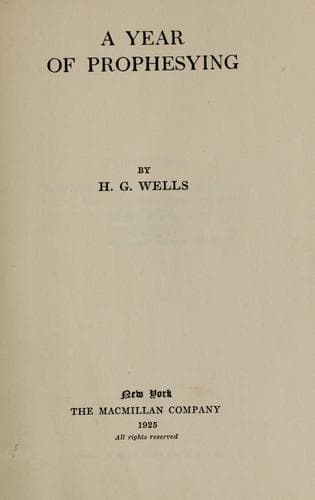
A year of prophesyingWells, H. G. (Herbert George)
History
A year of prophesying
Wells, H. G. (Herbert George)
Civilization, Modern -- 20th century; Europe -- History -- 20th century; Great Britain -- History -- 20th century
English-speaking peoples are beginning to realise that what they call
“democracy” may not be a universal panacea, and that Parliamentary and
Congressional government as it flourished in the nineteenth century
with two parties and a choice for the elector limited to two party
hacks, instead of being a method of universal validity and altogether
perfect, was a temporarily convenient method of government for a fairly
homogeneous dominant middle class living under apparently stable
conditions. Social developments in Western Europe evolved this class
throughout the eighteenth and nineteenth centuries, and a national
mentality was evolved concurrently. Transferred to alien soils,
parliamentary institutions wilt or become weedy. And it is extremely
doubtful whether in Britain, that mother of Parliaments, it is possible
for the parliamentary machine to work now except in a very hectic and
unsatisfactory way, unless it undergoes extensive adaptations to meet
the great financial, economic, and social stresses that have still to
try the British community.
In a previous paper I have discussed the electoral reforms whereby
Parliament or Congress could be made really representative of the
national mind, would cease to be an arena for a stupid and boring party
conflict, and would become a smaller assembly, a working council,
alive throughout, appointing and criticising the various Ministries.
But a reform of representative methods is not in itself a sufficient
solution to our problem. A graver and profounder weakness both of the
American and British community at the present time is the incoherence
and diffuseness of public opinion. Great changes in the range and
material of economic life during the last quarter of a century and
the financial earthquakes that have followed the war have shattered
the old homogeneous and dominant middle-class stratum on both sides
of the Atlantic. That was the reservoir of public opinion, and there
is nothing equivalent on the new scale to replace it. There have
been bold extensions of the franchise in Britain to great classes of
inexperienced and inattentive voters; Mr. Adamson’s Bill has brought
us within sight of universal suffrage for every man and woman over
twenty-one; but there has been no development of political education
upon the same scale. Probably a third of the British voting mass
after these additions--seven millions, say--will be too indifferent
to political issues to vote at all. A half, another ten or eleven
millions, will vote for trivial or silly reasons, and will certainly
never take the slightest trouble to sustain the Parliament it has
elected. Politically they will accept anything they get. They have
still to learn to consider politics seriously. There remains about a
sixth of the British electorate; less than five millions, a miscellany
of every sort of opinion and drawn from every class, with this much
in common, that it cares enough about politics to fight about them if
necessary.
Public-domain text, read in full here on John Shaqi.
Reviews
Reviews
No reviews yet
Be the first to share your thoughts on this work.
Elsewhere in the archive
Join the Discussion
Join the discussion
Sign in to leave a comment or review.
Sign InorCreate an account