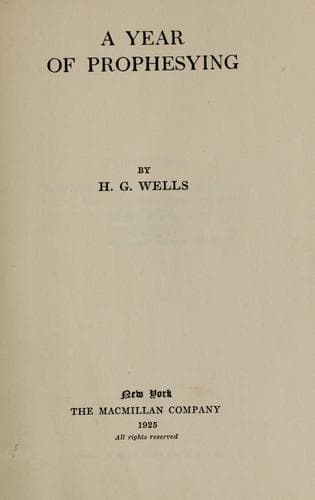
A year of prophesyingWells, H. G. (Herbert George)
History
A year of prophesying
Wells, H. G. (Herbert George)
Civilization, Modern -- 20th century; Europe -- History -- 20th century; Great Britain -- History -- 20th century
But if neither twenty-five nor twenty-one is a real natural division
line between the human being capable of citizenship and the junior,
the natural minor, where shall we draw that line? I would suggest
that we draw it at the age when the individual’s education comes to
an end. Education, we are assured, is to prepare the individual for
citizenship. When a State turns its young people out of its schools
into the streets to seek employment and toil for the community, it
tacitly declares that their preparation for citizenship is at an end.
If they are not prepared for citizenship they should not be turned out.
If they are, then they ought to go on at once to the most stimulating
exercise of the rights of citizenship, and vote before they forget
their lessons in history and geography and economics and so forth. Why
should they have to wait for years, forgetting nearly every general
idea they have learnt before the vote comes to rouse them? But the
reader will object that this means giving the vote to children of
fourteen or indeed in some American States to children even younger.
I submit that is no disproof of the principle I have laid down, but
only a disqualification of the shocking inefficiency of the educational
systems of the English-speaking world. We have no right to cheat our
young people out of their votes because we are defrauding them of the
best part of their education.
I am one of those people who believe that the minimum age at which
whole-time general education should cease is sixteen, and that for at
least two years more education in some form, a technical or industrial
training at least, associated perhaps with productive employment,
and a continuation of the general intellectual work should be given.
That would make eighteen the boundary between tutelage and complete
responsible citizenship. And to that age I am willing and anxious to
see the franchise extended. Education and the franchise are correlated
questions, and I do not believe a community can be in a sound state of
political organisation until education has moved up and the vote moved
down the scale of age to this meeting-point.
Public-domain text, read in full here on John Shaqi.
Reviews
Reviews
No reviews yet
Be the first to share your thoughts on this work.
Elsewhere in the archive
Join the Discussion
Join the discussion
Sign in to leave a comment or review.
Sign InorCreate an account