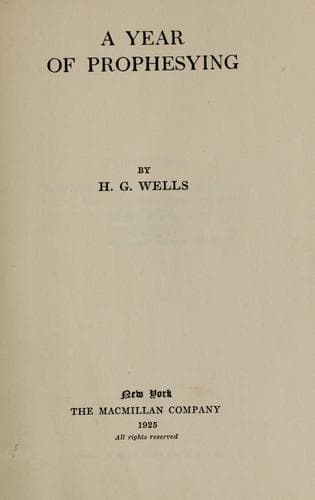
A year of prophesyingWells, H. G. (Herbert George)
History
A year of prophesying
Wells, H. G. (Herbert George)
Civilization, Modern -- 20th century; Europe -- History -- 20th century; Great Britain -- History -- 20th century
And finally let us consider the benefit to the country and the world
at large of a more youthful electorate. To bring in voters in their
nineteenth, twentieth, and twenty-first years will be to bring in
three million and more fresh minds, all unsettled as yet, all facing
the world adventurously. They will be a wholesome counterweight to
the grudging rate-payer, the small shopkeeper, the _rentier_, the
anxious and hopeless and fearful multitude of the unsuccessful and
defensive middle-aged, the great supporters of “Anti-Waste” campaigns,
“safety” armaments, policies of “security,” and all sorts of patriotic
cowardice. These elder folk think of the next quarter day or the next
year; it is all that interests them; they will be dead soon and they
want to shuffle along as comfortably and with as little troublesome
novelty as possible until then. The interests of the youth of eighteen
reach forward half a century and they may work with a reasonable hope
of a better world for themselves as well as their children. They may
have the more wisdom for the very reason that they have acquired less
worldly discretion. And for all of us who believe that education is
already touched by a new spirit and that it is surely being made
better, the younger the age of enfranchisement the greater our hopes of
an early effect of the new education upon the affairs of mankind.
“Universal education up to eighteen, universal enfranchisement at
eighteen”; along that line lies our path to a real civilisation. Along
that path we shall go as the breath of a new generation blows into
Congress and Parliament and these assemblies cease to be the gatherings
of political botchers and tinkers representing the broken spirit and
curtailed desires of a forty-year-old electorate. For round about forty
must be the average age of the present-day British elector.
XXX
OLIVE BRANCHES OF STEEL: SHOULD THE ANGELS OF PEACE CARRY BOMBS?
5.4.24
_The will for peace is futile without the courage to disarm._ I would
like to have that proposition printed in large letters and put up
at all the meetings of the British League of Nations Union, just to
see what the worthy practitioners in easy optimism who fill these
gatherings would make of it. I doubt if half the kindly idealists who
support the League of Nations in Britain and America are prepared for
any effectual disarmament of their own countries. For others--yes; but
not for their own dear land.
Public-domain text, read in full here on John Shaqi.
Reviews
Reviews
No reviews yet
Be the first to share your thoughts on this work.
Elsewhere in the archive
Join the Discussion
Join the discussion
Sign in to leave a comment or review.
Sign InorCreate an account