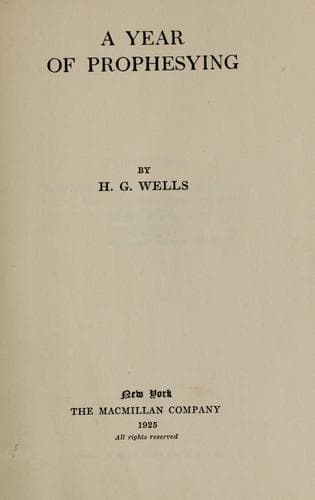
A year of prophesyingWells, H. G. (Herbert George)
History
A year of prophesying
Wells, H. G. (Herbert George)
Civilization, Modern -- 20th century; Europe -- History -- 20th century; Great Britain -- History -- 20th century
The urgencies of the British situation have put Great Britain far
in advance of the United States in this matter. There is a very
respectable movement for Proportional Representation in the United
States of America, but it has still to be realised as practical
politics and a serious need by the American public. In America every
citizen is born either a little Republican or else a little Democrat;
it does not matter what the Republican or Democratic platform is or
what sort of man is put up for him in his division, he has to vote
for his party. Or else go through a crisis almost like disowning his
father and mother and vote for the other party. There is nothing else
in the world for him to do in politics, just as there was nothing else
but being “either a little Liberal or else a little Conservative” in
the great days of Gilbert and Sullivan in London. The United States is
young, prosperous, and at a great advantage to the rest of the world;
it may be able to afford its present travesty of democracy for a long
time yet. Britain cannot. The party system has always been more rigidly
organised in America than in England. In Britain on the Left side,
counting Liberal, Labour, and Communist together, there are eight or
ten distinct schools of political thought and intention; on the Right
side there are five or six. The British voter grows more and more
erratic and uncertain under the present idiotic system, and the results
of General Elections more and more silly and incalculable.
The idea of Proportional Representation is now nearly a century old.
It is due to a clear-headed man named Hare. He proposed that a number
of candidates should stand for the whole country as one constituency.
The voter would vote for the man he liked and trusted best. If that
man were so widely liked and trusted that he got more votes than were
needed to return him, he would take as large a fraction of every vote
as he needed, and if the voter had indicated a second choice on his
paper, the rest of his vote would go to the candidate next on his list.
_Whatever happened, some or all of the voter’s support would go to the
man he had chosen._ That man would be his man par excellence. There
could be no more direct relationship between voter and representative.
But if that man were a very great and desirable man, the voter could
also congratulate himself on the partial possession of a second or even
a third, more personal representative. There are people who profess to
find great difficulty in understanding Proportional Representation;
mostly this is a purely wilful and subjective befuddlement. The
filling up of the voting papers is perfectly simple and the counting
and fractionation of the votes offers no difficulty to any properly
instructed educated person.
Public-domain text, read in full here on John Shaqi.
Reviews
Reviews
No reviews yet
Be the first to share your thoughts on this work.
Elsewhere in the archive
Join the Discussion
Join the discussion
Sign in to leave a comment or review.
Sign InorCreate an account