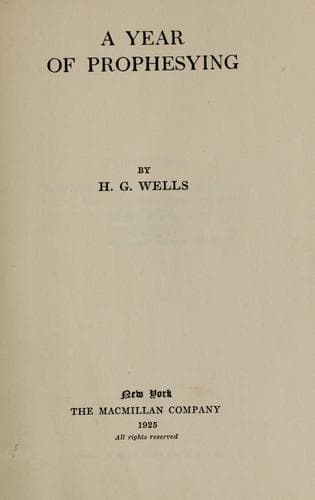
A year of prophesyingWells, H. G. (Herbert George)
History
A year of prophesying
Wells, H. G. (Herbert George)
Civilization, Modern -- 20th century; Europe -- History -- 20th century; Great Britain -- History -- 20th century
For trivial reasons Hare’s voting method, which would give us an almost
pure representative democracy, has been modified in all the practical
proposals made by the division of the country into large constituencies
instead of leaving it one whole, and the assignation of a limited but
still large number of members to each. But its virtue of comparative
veracity in representation still to a large extent remains. Mr.
Rendall’s recent Bill proposed constituencies returning not less than
three and not more than seven members. This is much too small for a
real representation of British opinion, but it was as much as the party
wire-pullers would allow. When the question is reopened this maximum
should be increased.
Of course the systems called Proportional Representation in use in
France and Italy are scoundrelly caricatures of the idea. Under them
the voters vote not for men but for party gangs, and the whole object
of Proportional Representation is to release men from servitude to
party manipulation.
The objections to the measure made in the debate upon the rejected
Bill were mostly very trivial or based on positive misconceptions.
The question was indeed not discussed. Most of the opponents from the
Labour side contented themselves with twitting the Liberal politicians
with change of heart upon the question. They behaved just as the
Liberal Party hacks did in 1918 because they are exactly the same
sort of men. The mentality of the party hack, Liberal, Labour, or
Conservative, is very much on a level in this matter. Most of the big
men in all parties are for Proportional Representation, because they
know they are outstanding enough to survive its establishment. The
party hack knows he lives through and by his party: the voter does
not choose him but suffers him, and at the first clear opportunity
the voter will push him out of the way and choose a more interesting
non-party man. About seventy Labour men who have at one time or
another professed approval of Proportional Representation did not vote.
The struggle against Proportional Representation is really the life
struggle of the professional party politician. Under Proportional
Representation the legislative assembly, instead of being elected by
a small majority, or even a minority of the voters in the country,
will be representative of nearly the whole country. In a constituency
electing ten members, for instance, there will probably be less than
a tenth of that constituency not actually represented by members
returned. This wipes out every hope of a bilateral political system,
because it will fill the assembly with free members, responsible only
to the voters who have returned them, and practically independent of
organised party support. They will necessarily be very various in their
opinions.
Public-domain text, read in full here on John Shaqi.
Reviews
Reviews
No reviews yet
Be the first to share your thoughts on this work.
Elsewhere in the archive
Join the Discussion
Join the discussion
Sign in to leave a comment or review.
Sign InorCreate an account