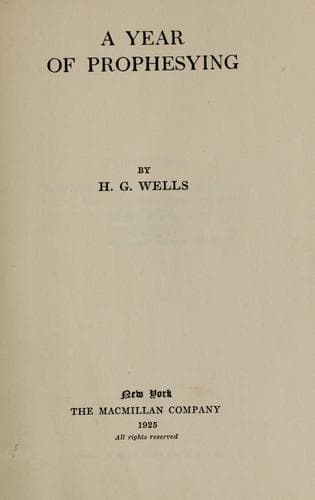
A year of prophesyingWells, H. G. (Herbert George)
History
A year of prophesying
Wells, H. G. (Herbert George)
Civilization, Modern -- 20th century; Europe -- History -- 20th century; Great Britain -- History -- 20th century
reprove the frightful negligences of the British in respect to Indian
education.
This, however, is in parenthesis. It is merely to emphasise the
fact that in this article I am instituting no comparisons at all. I
am taking a text from an American instance; that is all. There has
been a little tiff between the undergraduates and the authorities of
Harvard, and I find it extremely suggestive. The brighter of the
Harvard undergraduates, represented on the governing board of the
Harvard Union by Mr. Corliss Lamont, want to hear about Radicalism and
Communism at first hand from people like Mr. Debs and Mr. W. Z. Foster,
and the authorities are suppressing these youthful aspirations. They
want the young men who will presently sway American affairs to be fed
their knowledge of radical and revolutionary ideas by orthodox and
respectable persons who have pre-digested it for them and removed all
disturbing elements. The young men want the real stuff and to deal with
it themselves. I confess myself heart and soul for these young men.
There has recently been a controversy between Mr. Bertrand Russell
and President Lowell about the relative mental freedom of American
and British Universities. As Mr. Bertrand Russell was turned down for
pacifism from Cambridge during the war, he started in that controversy
with a handicap. It seems to me that such a dispute is bound to be
ineffectual. There are cases of mental restriction and suppression
from both sides of the Atlantic, and there are no scales invented yet
to weigh this case against that. The real conflict here is not between
American and European conditions, but between two types of men. It is a
conflict that rages throughout the entire world. Everywhere one finds
the managing, directive, limiting type of mind with a craving to get
on to governing bodies, the industry to get on governing bodies, and
a consequent tendency to get on governing bodies. Everywhere we find
also a less abundant supply of critical, sceptical, creative, restless
minds producing innovations and stimulating ideas and with an equal
tendency to get thrown out of organisations and governing bodies. They
are the seed, the ferment, the living factor in the human mind. In Dr.
Nicholas Murray Butler America has produced the perfect specimen of the
former class, just as in the late William James and in James Harvey
Robinson she has produced excellent samples of the second. It is loudly
boasted in British intellectual circles that Britain could not have
produced Dr. Nicholas Murray Butler, but so far as I am able to judge
there is as much Nicholas Murray Butlerism in Britain as in America,
as much large empty active influential pretentiousness, though it may
be more diffused, and it is at least as resolute to sit upon and addle
intellectual institutions.
Public-domain text, read in full here on John Shaqi.
Reviews
Reviews
No reviews yet
Be the first to share your thoughts on this work.
Elsewhere in the archive
Join the Discussion
Join the discussion
Sign in to leave a comment or review.
Sign InorCreate an account