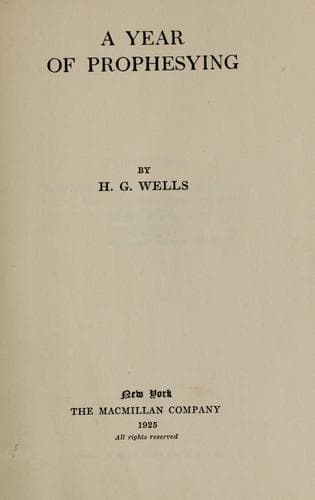
A year of prophesyingWells, H. G. (Herbert George)
History
A year of prophesying
Wells, H. G. (Herbert George)
Civilization, Modern -- 20th century; Europe -- History -- 20th century; Great Britain -- History -- 20th century
For the peculiar evil of the governing body type is its failure to
understand its lack of finality. It has no sense of the unknown, no
sense of the provisional nature of all mundane things. It wants to fix
knowledge in its own image, to make subsidiary and to apportion and
departmentalise the work of the gifted exceptional and disturbing men.
It seeks to set up classics, to perpetuate existing institutions, to
inaugurate ancestor worship. Dr. Nicholas Murray Butler is to be the
American Confucius and stereotype this perfect world of 1924; the last
of the Founders. The coming generation will learn that at this point
the world congealed. The thing this dominating type dreads supremely is
revolutionary suggestion and the possibility of the young getting away
with new ideas. Its educational ideal is blinkers and an obedient youth
looking neither to the right nor the left, but pursuing the one right
path.
But the sustaining factor of life is death. Happily, most happily,
Founders die, and their codes and constitutions, their classical
utterances, die and pass away. Even the inspired addresses and
deliverances of Dr. Nicholas Murray Butler, so beautifully printed and
so relentlessly distributed, will some day shrivel and pass, and be no
more heeded. So that life may go on. Without death there could be no
birth. The most fundamental fact about youth is its disrespect for its
elders and the past. That is what it is for. A generation that wanted
to repeat the preceding generation would not be birth, it would be life
stuttering. And the one thing youth does most need and want and fight
to get, as its supreme instinctive duty, is and always will be every
sort of destructive criticism of existing authorities, of the existing
order, and of established institutions. Young America at Harvard
probably has no illusions about Mr. Debs or Mr. Foster; it calls them,
I am reasonably certain, “Old Debs” and “Old Foster.” But it means to
hear them, it will hear them, and the college authorities had better
help it to hear without any attempts whatever to jam the message
Old Debs and Old Foster have to deliver against the old system young
Harvard has been born to alter--and has been born for no other apparent
end that I can see.
Public-domain text, read in full here on John Shaqi.
Reviews
Reviews
No reviews yet
Be the first to share your thoughts on this work.
Elsewhere in the archive
Join the Discussion
Join the discussion
Sign in to leave a comment or review.
Sign InorCreate an account