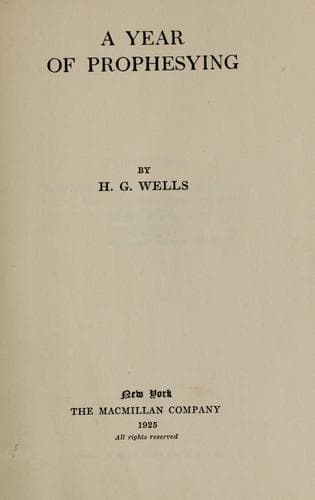
A year of prophesyingWells, H. G. (Herbert George)
History
A year of prophesying
Wells, H. G. (Herbert George)
Civilization, Modern -- 20th century; Europe -- History -- 20th century; Great Britain -- History -- 20th century
America has not enough peasants. This is an interesting development,
or perhaps I had better say an interesting lapse, in the ideas of a
woman we had come to regard, perhaps rashly, as a boldly progressive
spirit. This is turning back to the earthy romanticism of Belloc and
Chesterton, and I think it shows the profoundest misapprehension of
the fundamentals of the American situation. America has not developed
a peasant population--for it is sheer perversity of Miss West to write
as she does of Abraham Lincoln as a peasant’s son, as a traditional
plough-driver, instead of an axe-wielder from the East. America, with
machines to plough straighter and deeper than any clodhopper can ever
do, has no need of peasants for any purpose at all, except perhaps
as negro cotton-growers in the South. America is not developing a
peasantry and probably never will. At present the drift to the towns
is continuous, and rural depopulation is as present a problem in the
United States as in Great Britain.
That Miss West should associate civil order with a peasantry shows
an odd forgetfulness of European conditions. England, which has had
practically no peasantry for two centuries, but only wage-earning
labourers, displays the greatest social order and security in the
world; Russia, which is practically all peasantry, can, and could
before the war, show a lawlessness, an indiscipline and social
insecurity far exceeding anything of which Miss West complains in
America. I would as soon accept Zola’s valuation of the peasant in _La
Terre_ as Miss West’s discovery of him as the soil from which all the
social virtues spring.
It is in quite another quarter that I should look for the forces
that will ultimately adjust and bring together into a law-abiding
social harmony all the loose and conflicting elements of the American
State, and that is in a great development of schools and colleges.
It is from the head and centre and not from the base that the modern
community must be unified. It is a point that Miss West seems to ignore
altogether, that the United States is, in spite of the aggregatory form
of its constitution, the first instance of a new type of community
altogether, the type that steam railways, electrical communications,
and power machinery have made possible. It may have much trouble and
darkness in its destiny, but nothing but complete disaster can ever
lead to another repetition of that levelling down and earthing up
of the human spirit in peasant life that underlies the old-world
civilisations. The chief faults and merits of American life are alike
the characteristics of a released population that has escaped from that
intimate servitude to pedestrian locality, to the dungheap, the patch,
the hovel, and the bitter narrow outlook, for ever.
Public-domain text, read in full here on John Shaqi.
Reviews
Reviews
No reviews yet
Be the first to share your thoughts on this work.
Elsewhere in the archive
Join the Discussion
Join the discussion
Sign in to leave a comment or review.
Sign InorCreate an account