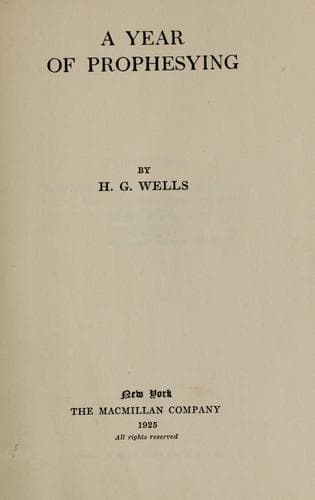
A year of prophesyingWells, H. G. (Herbert George)
History
A year of prophesying
Wells, H. G. (Herbert George)
Civilization, Modern -- 20th century; Europe -- History -- 20th century; Great Britain -- History -- 20th century
Schools and Universities are surely the most paradoxical things in
the whole preposterous spectacle of human life. They exist to prepare
youth for a world of enormous changes, and their chief activity seems
to be, at Oxford and Cambridge quite as much as at Harvard and Yale,
to get youth apart from the world and conceal the forces of change
from its curious and intelligent eyes. The youth of the Universities
in particular should be the living eggs of the good new things of the
days to come. The efforts of the governing bodies everywhere seem to be
directed chiefly to getting them hard-boiled. My congratulations to Mr.
Corliss Lamont for having so far escaped the culinary process. Nowadays
there are Corliss Lamonts from China to Peru. The matter and the forms
change but the spirit is the same. In Moscow they have to fight as hard
as anywhere else; there it is to escape being made into hard-boiled
Communists. By virtue of the rebellious vitality in our youth this
world of mankind lives on and does not die and freeze into a monument
to its Founders.
XLII
THE LAWLESSNESS OF AMERICA AND THE WAY TO ORDER
21.6.24
Miss Rebecca West, that acute and brilliant observer, has recently been
in America, and she has been writing her impressions of the American
scene. She has been lecturing and hand-shaking, but with commendable
restraint she says little of her audiences, her hotels, and her railway
journeys. She has looked over the heads of her hearers and out of the
carriage windows. She has looked at the great spectacle as a whole, and
she generalises about it broadly and bravely.
The lack of civil order is the thing that strikes her most, and she
illustrates her perception of it by a vivid and illuminating discussion
of the necessity for prohibition and its consequent evils, and of the
colour trouble in the South. Various previous British visitors have
noted that lack in other terms, have remarked upon the want of a sense
of the State in American thought, and of the reaction upon humanity of
the fierce, untutored naturalness, the wide deserts, the undisciplined
rivers, and spontaneous tangled forest growths of the New World.
But when she looks for the forces that will presently bring order and
graciousness into this characteristically splendid display of energy
at large she calls rather startlingly for peasants. She thinks, in a
phrase that might have come straight from something by Chesterton, that
“nameless men who plough furrows that are straight and deep,” peasants
in bulk and multitude, are needed to establish a permanent social
order, an enduring and developing civilisation.
Public-domain text, read in full here on John Shaqi.
Reviews
Reviews
No reviews yet
Be the first to share your thoughts on this work.
Elsewhere in the archive
Join the Discussion
Join the discussion
Sign in to leave a comment or review.
Sign InorCreate an account