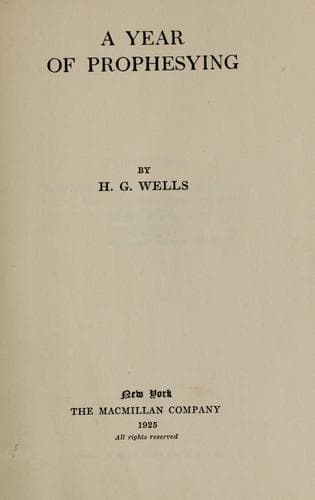
A year of prophesyingWells, H. G. (Herbert George)
History
A year of prophesying
Wells, H. G. (Herbert George)
Civilization, Modern -- 20th century; Europe -- History -- 20th century; Great Britain -- History -- 20th century
The Jesuits in South America seem to have done well in a kindly
unprogressive way; the British rule in Nigeria and some of the West
Indies is a comparatively bright spot in the history of racial
interaction, the Maoris and the Basutos seem to be well-treated
peoples, and the Dutch are credited with a fairly happy and prosperous
Java. Until the last few years the British Empire seems to have dealt
justly with its old allies, the Six Nations in Canada. These are
outstanding exceptions. The general rule for peace between two races
seems to be mix or get away; the darkest tragedy comes when, as in the
southern United States, they can neither mix nor disentangle.
In the great elaborately educated State of the future towards which
human affairs are moving, everyone and every community will be most
sedulously educated and trained in inter-racial good manners. Our world
at present has scarcely such a thing yet as good manners in anyone or
a fully educated man. All the more reason, then, for maintaining the
separation of peoples unfit to associate generously and peacefully with
each other, and for releasing those who are not already separated.
The recent libel case brought by Sir Michael O’Dwyer against Sir
Sankaran Nair has brought out very vividly the tremendous failure of
the British Imperial system, after a century of opportunity, to produce
any working tradition of interaction between the British people, the
British garrison, and the Indian population. It has demonstrated the
impossibility of any very long continuation of British rule in the
peninsula.
After one has looked into the particulars of the case, one has just the
same depressing realisation of a hopeless incompatibility that one has
in some matrimonial cases. It is not so much that this or that has
been done or not done; it is that the two peoples are unequally yoked
in temperament and intelligence; that they do not get on together; that
they never will get on together while they are closely associated. The
British are not good enough nor wise enough for the job; the Indians
are not great enough nor patient enough. It is a case for a separation,
as friendly and speedy a separation as possible, if there is not
presently to be a tragic divorce.
I must confess that I cannot conjure up any very profound indignation
against General Dyer. He was, I think, stupid, spasmodically violent,
and unnecessarily bloody. I do not believe that the shooting at
Amritsar was inevitable, and he certainly went on shooting too long.
But the sort of stupid and spasmodic violence he displayed is very
characteristic of many English and many Americans. I find it in myself.
I have not, luckily for myself, had General Dyer’s opportunities,
but it is not necessary to kill people to discover that one may be
harsh and cruel when one is thwarted by mental processes one does not
understand.
Public-domain text, read in full here on John Shaqi.
Reviews
Reviews
No reviews yet
Be the first to share your thoughts on this work.
Elsewhere in the archive
Join the Discussion
Join the discussion
Sign in to leave a comment or review.
Sign InorCreate an account