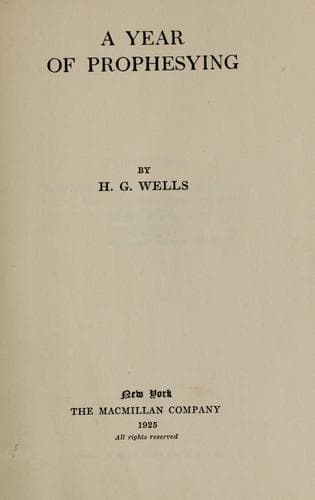
A year of prophesyingWells, H. G. (Herbert George)
History
A year of prophesying
Wells, H. G. (Herbert George)
Civilization, Modern -- 20th century; Europe -- History -- 20th century; Great Britain -- History -- 20th century
I had a Dyer phase, for example, as a young, eager, and untrained
schoolmaster, whipping-in the difficult stragglers for class work
against which they rebelled. The whole story of the Punjab troubles
is really a very pitiful story not only for the native population
but for the British administrators. It is the story of a conflict of
resentments. One begins with an officialdom eager for “volunteers”
for the Great War, unable to understand that the Great War meant
nothing and should have meant nothing to any reasonable Indian person.
How could it matter to them? One goes on to a story of “pressure”
increasing in its ugly details until we come to thrashings, deep
indignities, and tortures to stimulate the cheerful “volunteer.”
Pressure passes from chief to subordinate and degenerates towards
cruelty at every transition; it is hard to fix responsibility at any
point. It rouses resistance. The pestered and tormented populace
begin to hold meetings, make vague gestures of counter violence. The
irritable ass in the Anglo-Saxon make-up responds with “firmness.” The
firmness loads the rifles and prepares aeroplane bombs to disperse
“dangerous assemblies.”
There is a mood of scared obstinacy in which the Anglo-Saxon becomes
capable of almost any swift atrocity. He is rarely deliberately cruel,
but he is easily clumsily and hotly cruel. In the twilight the highly
strung creature will shoot or lynch at very slight provocation indeed.
Confronted with the dead body, his self-respect demands an adequate
reason for the murder he has done. So soon as the Amritsar gardens
were littered with dead and dying people, it became clear to General
Dyer that a very dangerous rebellion, a second Indian Mutiny, had been
heroically nipped in the bud.
His military superiors did not think so. He was rebuked and punished,
very properly, very necessarily. Some amends were made to smitten and
outraged India in that treatment of General Dyer, and the wretched
incident of Amritsar would have passed into the receding perspectives
of history if it had not been for the litigious enterprise of Sir
Michael O’Dwyer. Sir C. Sankaran Nair, in a book that was extensively
used by the British Government for propaganda purposes in India, wrote
phrases that certainly put an unjustifiable blame upon Sir Michael
O’Dwyer for the Punjab outrages. Sir Michael brought his action and
reopened the question.
Public-domain text, read in full here on John Shaqi.
Reviews
Reviews
No reviews yet
Be the first to share your thoughts on this work.
Elsewhere in the archive
Join the Discussion
Join the discussion
Sign in to leave a comment or review.
Sign InorCreate an account