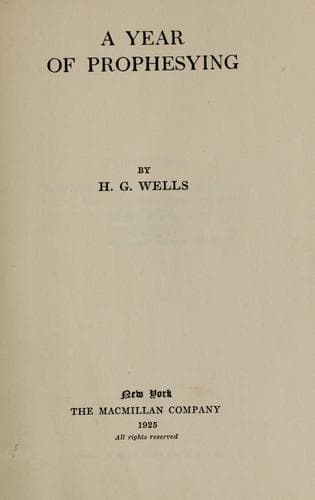
A year of prophesyingWells, H. G. (Herbert George)
History
A year of prophesying
Wells, H. G. (Herbert George)
Civilization, Modern -- 20th century; Europe -- History -- 20th century; Great Britain -- History -- 20th century
Now the alarming and disconcerting thing is that the Court of King’s
Bench showed itself far less intelligent, far less alive to the
realities of the Indian situation, than General Dyer’s military
superiors in India. It is impossible to read the reports of the case
without realising that the mutual irritation of English and Indian,
the profound temperamental incompatibility of the two worlds, was
manifested in that Court in an exaggerated degree. The case transcended
its proper limits and became a wrangle on the whole Punjab question.
Mr. Justice McCardie took upon himself to inform the world at large and
the people of India in particular, with all the weight and prestige of
the High Court upon him, “speaking with due deliberation,” that in his
view General Dyer had been wrongly punished by the Secretary of State
for India.
The case of General Dyer was not before the Court. This announcement
was a lawless outbreak on the part of Justice McCardie. How much due
deliberation there was in Justice McCardie’s utterance and how much
instinctive passion may be judged by the fact that General Dyer does
not seem to have been punished by the Secretary of State for India at
all; his case did not come up to the Secretary of State for India;
he was punished for his hasty excessive violence by his own proper
military superiors in India. Internal dissension restrained the jury
from inflicting excessive and exemplary damages upon Sir C. Sankaran
Nair for his careless libel; the damages awarded amounted to five
hundred pounds, but it will be very difficult, it will be impossible,
to persuade the sore and sensitive, quick and resentful mind of India
that Britain has not gone back upon even such clumsy and insufficient
apologies and atonements as she had made for Amritsar and its
associated sins.
There comes a time in the relationships of nations and peoples, as in
the relationships of partners and lovers and married couples, when
offences become irrevocable. The breaking point seemed to have been
reached by the British in India. The argument is practically over,
the negotiations at an end. When in the opening stages of the Great
War Ireland was bilked of Home Rule there remained nothing for it,
between Britain and Ireland, but a practical separation. Englishmen
like myself, who regard the present detachment of Ireland and England
as excessive and regrettable, were entangled, in spite of themselves,
in that offence; and we were helpless to avert its just and logical
consequences. So now with India. It is a sort of treachery to Indians
to go on talking liberally to them, to seek their friendship, to
attempt co-operations, with Dyer’s impenitent rifles reloaded and our
Justice McCardies ready and eager to tear up our poor attempts to make
amends.
XLV
THE SPIRIT OF FASCISM: IS THERE ANY GOOD IN IT AT ALL?
12.7.24
Public-domain text, read in full here on John Shaqi.
Reviews
Reviews
No reviews yet
Be the first to share your thoughts on this work.
Elsewhere in the archive
Join the Discussion
Join the discussion
Sign in to leave a comment or review.
Sign InorCreate an account