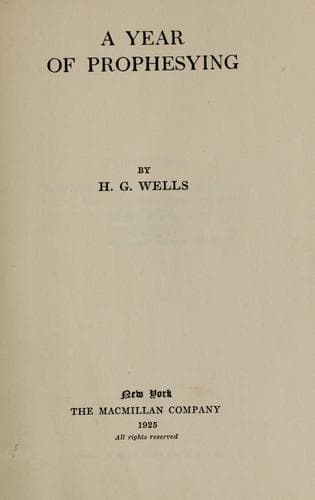
A year of prophesyingWells, H. G. (Herbert George)
History
A year of prophesying
Wells, H. G. (Herbert George)
Civilization, Modern -- 20th century; Europe -- History -- 20th century; Great Britain -- History -- 20th century
THE RACE CONFLICT: IS IT UNAVOIDABLE?
19.7.24
The action of the United States in setting aside its gentlemanly
understanding with Japan in the matter of immigration and excluding the
Japanese altogether has greatly exercised the British mind. At this
distance it strikes us as an altogether uncivilised thing to do. We
believe that for all practical purposes the peace of the Pacific rests
on the tripod, America, Britain, Japan; we attached immense importance
to the Washington Agreement and the feeling of concord it developed;
we abandoned the Anglo-Japanese alliance to American feeling and,
after a struggle at home, the threat of the Singapore developments was
withdrawn. Our dominant idea was the collaboration, mutual trust, and
mutual forbearance of three great civilised Powers. Then, apparently
as a move in the dismal party game that still rules American political
life, in order to secure California for the Republican Party, Japan
is smacked on the face good and hard, and most of this difficult and
elaborate work of reassurance is undone.
It is not a question of excluding cheap labour or alien mass
immigration; that has been fairly well done for some time. It is an
intolerable assertion that individual educated Japanese are unfitted by
race and culture for helpful participation in the high civilisation of
the Pacific Coast. It implies that Japanese and Americans are for ever
incompatible, are for ever two peoples; that for ever on this little
planet their destinies are to be worked out parallel or apart--or to
mingle only in a bitter conflict for exclusive survival.
These are immensely dangerous implications. It is impossible to believe
that they express the real intelligence of the American public in this
matter. But they do express a very widely diffused feeling, prevailing
especially on the Pacific slope. That same reckless levity of the party
politician, which in Britain in the “great days” of Gladstone and
Disraeli, made the relations of Russia to Britain a mere party counter,
has appealed to that feeling. We are forced to recognise that a great
multitude of people in California and elsewhere are at a mental level
from which it is possible to contemplate a future of pent-up races and
cultures, each living in its own bit of the little planet and forcibly
restrained from wandering or expanding beyond its boundaries.
Is such a future possible for mankind? It was, one must admit, a
dominant idea in the past. More’s _Utopia_ and most of the old Utopias
were closed countries. Japan itself was a completely closed country
for several centuries, and no one went into or came out of it. It was
Americans who forced the closed door of Japan; they of all peoples have
the least reason to complain of the Japanese spill-over into their
world. But no country yet tolerates the free movement of peoples. Yet
the secular force of human inventiveness fights against this system of
pen and barrier.
Public-domain text, read in full here on John Shaqi.
Reviews
Reviews
No reviews yet
Be the first to share your thoughts on this work.
Elsewhere in the archive
Join the Discussion
Join the discussion
Sign in to leave a comment or review.
Sign InorCreate an account