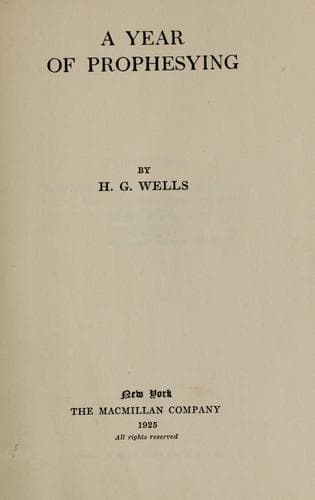
A year of prophesyingWells, H. G. (Herbert George)
History
A year of prophesying
Wells, H. G. (Herbert George)
Civilization, Modern -- 20th century; Europe -- History -- 20th century; Great Britain -- History -- 20th century
Our States, our boundaries become intolerably small to the new
methods of communication, to the broadening general intelligence. Our
economic lives, in spite of tariffs and the most strenuous resistance,
spread out to the ends of the earth. Financially the world is one. No
peoples on the earth travel and migrate more widely, or would suffer
more acutely in mind and spirit from the complete restriction of
international movement than the British and Americans--the Americans
even more now than the British. But we cannot go thrusting our white
faces into the markets of Timbuctoo, the bazaars of Central Asia, and
the temples of Osaka, if we refuse to see brown and black and yellow in
the street cars of Chicago and London. There is a plain antagonism of
ideals here, between a venerable parochial and a new planetary mind. Is
it not time for us to sort out our ideas in these matters a little more
exactly?
Opinion lies between the absolute exclusionist and the free mixer. Most
of us find ourselves somewhere intermediate between these extremes. The
case of the exclusionists is based on just these increasing facilities
of communication which make others think that at any cost the world
must become one united system. This quicker and closer intercourse
is intensifying racial clash. It was all very well when only a few
foreigners could travel with difficulty to one’s country, but now they
come in multitudes, they come to settle, they congest in lumps too
solid for assimilation. It is necessary, says the exclusionist, to make
the barriers higher and stronger. Yet is this more than a temporary
arrest of racial conflict in a world where finance is world-wide
and every people has a need, a necessity for the produce of lands
unacceptable to it? In a world, too, of increasing hygienic knowledge,
in which populations tend to increase and overflow? Is it anything more
than the opening phase of a development of an antagonism whose natural
end is war?
It seems to me that the forces that make for material world
unification, the forces of invention and enlightenment, are now so
great, various and subtle that they cannot be defeated. They may be
delayed, but in the end they will be stronger than any exclusionist
localism. The practical question before mankind is how we are to react
to these forces; and the practical alternatives are either a vast cycle
of wars and race conflicts, race riots, tyrannies of secret societies,
struggles for ascendancy ending perhaps after many centuries of tragedy
and wasted opportunity in the complete triumph of some specific
culture, or a deliberate attempt to minimise race hostility, devise
fair methods of co-operation and work out a mixed and various world
society with a code of mutual tolerance and service for the common good.
Public-domain text, read in full here on John Shaqi.
Reviews
Reviews
No reviews yet
Be the first to share your thoughts on this work.
Elsewhere in the archive
Join the Discussion
Join the discussion
Sign in to leave a comment or review.
Sign InorCreate an account