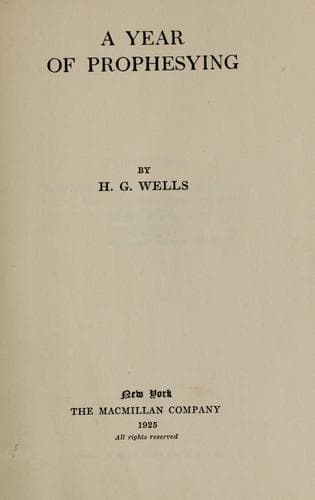
A year of prophesyingWells, H. G. (Herbert George)
History
A year of prophesying
Wells, H. G. (Herbert George)
Civilization, Modern -- 20th century; Europe -- History -- 20th century; Great Britain -- History -- 20th century
It is under a confusing number of heads a tirade against the hostility
of man to woman. Instances from all the ages jostle one another. Men
do not even give women fair literary criticism, and this point is
rather stressed. Mr. Birrell disliked the work of Hannah More; Mr.
Max Beerbohm, in a delightful and probably untruthful sketch, says he
cut up and burnt a work by some woman novelist unnamed. But I doubt
if strong sexual feeling underlay either offence. It happened to be a
woman novelist. But Mr. Max Beerbohm has been distinctly unflattering
to various men contemporaries, and I doubt if Mr. Birrell would wallow
in praise of Herbert Spencer. It happens that I have annotated several
of the works of Professor Nicholas Murray Butler in a disparaging
spirit; marginal illustrations are my weakness; and I have been at
great pains to destroy by fire a large nobly printed card, very thick
and strong and stylish, exhibiting one of his aphorisms. It was sent me
by some American admirer we evidently share between us; it was probably
intended to dominate my bedroom or study; and it found a useful rôle at
last, charred but invincible--for fire recoiled from it--as packing for
a picture. I suppose these facts would win me a place side by side with
Mr. Birrell and Mr. Max Beerbohm in a revised edition of _Ancilla’s
Share_. As it is they merely prove that we all have our literary
dislikes. I don’t think Jane Austen has any case against men for lack
of appreciation. I don’t think that any writing woman of Miss Robins’s
generation can complain of anything in her reception by male critics,
except perhaps a too eager welcome.
But I will not embark upon any detailed treatment of the confused riot
of assertions against men in this book. Need one even pretend to take
seriously Miss Robins’s proposition that women would have managed the
world better than men have done, that they would have prevented the
world war and arrested the financial disorganisation of Europe? This
talk of Ancilla’s tremendous nobility in the political field is sheer
nonsense. So far the enfranchisement of women in Britain and America
has had a confusing and belittling influence upon politics. It was the
women’s influence in politics which achieved the crowning silliness of
making Prohibition a part of the constitution of the United States, and
in England women have done nothing to save the face of the countryside
from Mr. Wheatley’s dismal women-enslaving house pustules. The drive
for better education is no stronger than it was before our sisters
had the vote; the drive for more scientific research is perceptibly
feebler. Disarmament is manifestly a question of minor importance to
women. Nevertheless this book proves by its temper what it fails to
prove by its arguments, that sex antagonism is a fact of very great and
increasing importance in our world.
Public-domain text, read in full here on John Shaqi.
Reviews
Reviews
No reviews yet
Be the first to share your thoughts on this work.
Elsewhere in the archive
Join the Discussion
Join the discussion
Sign in to leave a comment or review.
Sign InorCreate an account