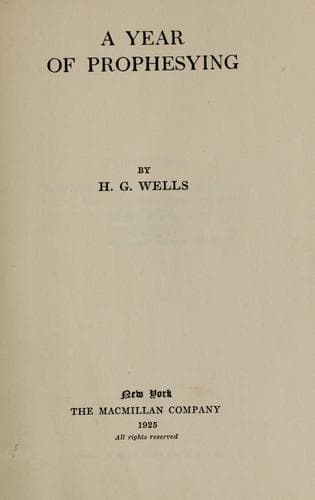
A year of prophesyingWells, H. G. (Herbert George)
History
A year of prophesying
Wells, H. G. (Herbert George)
Civilization, Modern -- 20th century; Europe -- History -- 20th century; Great Britain -- History -- 20th century
They may do so when they read an inspiring book by the fireside or
hear a rousing speech, but they do not do so all round the twenty-four
hours, or, indeed, at any time when there is any possibility of helping
to realise such generous desires. “They,” I write, but I should write
“we.” For we all are much of the same quality; the tallest man in the
world is not much more than twice the height of the shortest, and the
crime for which the murderer dies is just the concrete realisation of
the saint’s flash of anger. We are all but very little above egotism;
our passions are warm only when they are immediate. I do not believe
there has ever been a man who has lived steadfastly, continuously,
and completely in pursuit of great ends. We are all vain, amenable to
flattery, stirred by physical impulses, by the competitive instinct and
jealousy, by anger at opposition, liable to fatigue, irritation, and
uncontrollable and sometimes quite unaccountable fluctuations of motive.
Simple people like to believe there are Great Men in the world who are
altogether above this tangle of drive and impulse. But indeed there are
no such divinities.
What do we all find in our hearts? An immense self-love, a tremendous
concentration of our attention upon our personal drama, physical
cravings bare and physical cravings disguised and sublimated, desire to
possess, desire for securities, and such-like fear-begotten desires,
a desire for praise and approval and an instinctive dread of the
disapproval and hostility of our fellow-men, an aggressive pride and
self-assertion so soon as fear is allayed. We find, too, imitative
impulses, competitive impulses--jealousy. In most cases there is also
an extension of our egotism to cover our offspring, our dear ones, our
friends and near kin. It is an extension of our egotism rather than a
suppression of it. Is not that the drive and quality of most of our
living?
How much of that complex of motives can be used to bind men together
into a civilised state? One can no doubt play upon their fears,
represent the dangers of conquest and cruelty by hostile peoples so
vividly as to make them fight and compel others to fight for them
in great wars, rally them to the flag in a state of panic, fill them
with that frantic distrust and hate of strangers which is the basis of
vulgar “Patriotism.” With a little coercion one may even get them to
pay national taxes under the influence of these same mass-fears. The
human animal is a semi-social animal, and though you cannot stampede
it, as the American bison used to be stampeded, to rush over cliffs in
a heaped herd-suicide, or like the Russian lemming to swarm into the
sea and be drowned; yet it can be got moving in masses for collective
ends, either good ends or bad ends, in an only very slightly rational
manner.
Public-domain text, read in full here on John Shaqi.
Reviews
Reviews
No reviews yet
Be the first to share your thoughts on this work.
Elsewhere in the archive
Join the Discussion
Join the discussion
Sign in to leave a comment or review.
Sign InorCreate an account