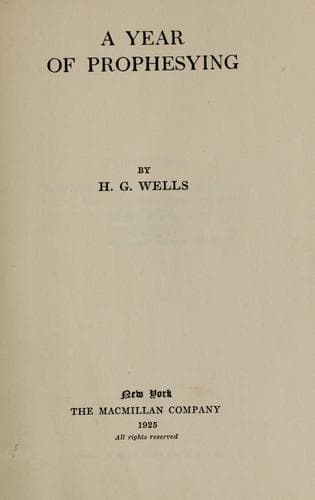
A year of prophesyingWells, H. G. (Herbert George)
History
A year of prophesying
Wells, H. G. (Herbert George)
Civilization, Modern -- 20th century; Europe -- History -- 20th century; Great Britain -- History -- 20th century
But though these human motives I have cited so far do serve to keep us
human beings together in smaller and larger communities with a sort of
mutual restraint and help and tolerance, they supply no real force for
any progressive betterment of human relations, and still less do they
supply any driving force to organise and maintain a higher order of
civilisation throughout the world.
As soon as the mass urgency subsides we tend to relapse into our own
little personal lives of eating, drinking, and “having a good time,”
of “getting on,” of posing to ourselves and others, of thinking and
talking ourselves into agreeable states of self-approval, of doing
pleasantly spiteful things to people we dislike. And if there is
nothing more in our human composition than these common impulses of
the everyday life, this coarse stuff of our common humanity, then all
our talk and writing about a world peace and a higher civilisation
is just dream stuff and nonsense. If that is all we are then we have
no more chance of escaping more wars, more famines and disorders,
cruelties, and diseases than a trainload of hogs bound for Chicago has
of escaping the stockyard. None of the hogs may like the journey to the
stockyard, or their experiences when they get there; that does not help
them in the slightest degree to escape their destiny.
But there is something more in humanity than this, and it is this
something more that transfuses all our life, our politics, our business
and social organisation, with the colour of romance and the quality of
a great adventure. Let me take two common incidents to show the kind of
“something more” that I mean--the something more in which all our hopes
reside.
It is night on the embankment of a river that flows through a great
city, and a commonplace youngster leans over the parapet watching and
thinking. Great warehouses, tall buildings, a tower or so, three or
four graceful bridges, one beyond the other, set with bright lights
and bearing a luminous traffic, drop their images into the stream, and
each light they bear makes a long, slightly wavering reflection upon
the smooth black water. A little steam-launch, just blackness and a red
head-lamp, fusses by. As it passes it tears through these tranquil
banks of lamp reflections, drags a trail of startled and trembling
shreds of light behind it, flings them apart, elongates them, re-unites
them, weaves them into a dancing pattern that changes every moment into
a fresh intricacy. Splash, splash, splash, comes the impact of the
little boat’s wash against the embankment. The youngster, struck with a
strange wonder of beauty, watches these changes, tries to follow them,
tries to detect the law of their dexterous, wonderful rearrangements.
All the heat and egotism of his personal life are forgotten. He is
lifted outside all our everyday scheme of motives. He is possessed by
the desire to know and understand.
Public-domain text, read in full here on John Shaqi.
Reviews
Reviews
No reviews yet
Be the first to share your thoughts on this work.
Elsewhere in the archive
Join the Discussion
Join the discussion
Sign in to leave a comment or review.
Sign InorCreate an account