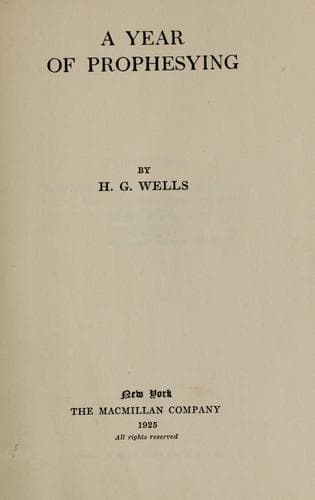
A year of prophesyingWells, H. G. (Herbert George)
History
A year of prophesying
Wells, H. G. (Herbert George)
Civilization, Modern -- 20th century; Europe -- History -- 20th century; Great Britain -- History -- 20th century
“Put a number of smooth, round balls upon a billiard table. Give them
each a slow and slight movement, and you will see no general movement
appearing. There will be little clatter, few and rare collisions.
Impart to them each a very rapid motion, that is, an individual
intensity, and while you raise very greatly the noise of the shocks
(which is a superficial phenomenon), and while you increase even more
the number and frequency of collisions (which is the cause of the
noise), you also soon develop a resultant of all the directions. If
the sharp speed of each be maintained you will soon perceive in the
movement of the whole a general swing, and all that great mass of balls
will be moving in a crowd. So it is with a human society.”
One likes to think of that rosy dinner party adjourned to the
billiard-room and “poon thesh soshial lawsh to pra’l tes’” by imparting
the motion as directed.
But apart from the almost wilfully preposterous side of Mr. Belloc
there is much to interest us in him profoundly. He is vigorously
expressive; he speaks for forces in our community that are more often
silently active; he gives resistances animation. The least original
of contemporary writers, he has retained the leading ideas of an
upbringing that was essentially Catholic and Latin in a practically
inflexible form. His world, after a few merely preparatory phases and
with a polite gesture to the Greeks, begins and ends with Rome. His
mind in this age of tumultuous growth is like a naughty and growing
child refusing to be put into larger clothes. And yet he is not blind
to the great volume of reality outside that narrow old-fashioned scheme
of his. He is not a blind man; he has at once vision and an extreme
obstinacy. He feels and denies the passing of mediaeval Europe, he
struggles against his realisation of the coming of a new order in the
world, which shall comprehend, for example, Siberia and China and
America, and a world-wide culture into which Islam and Christendom,
the wisdom of India and China and the science of Britain and Germany
and America and France and North Italy and Russia and Japan shall
alike fall and be fused. One probable factor in this synthesis will be
the English language, the great political and scientific traditions
it carries with it, and the band of English-speaking communities,
still growing and still crude, which will bring those traditions into
fruitful relationships with a thousand new conditions and a thousand
new climatic conditions. Rome will have a scarcely more important place
in an English-knitted world than Babylon.
Public-domain text, read in full here on John Shaqi.
Reviews
Reviews
No reviews yet
Be the first to share your thoughts on this work.
Elsewhere in the archive
Join the Discussion
Join the discussion
Sign in to leave a comment or review.
Sign InorCreate an account