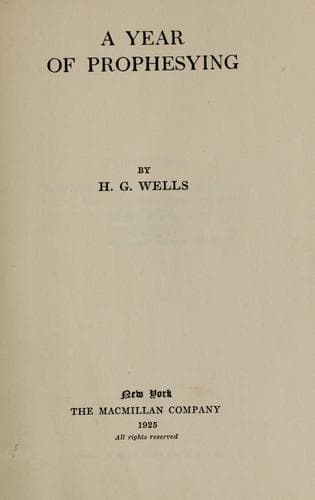
A year of prophesyingWells, H. G. (Herbert George)
History
A year of prophesying
Wells, H. G. (Herbert George)
Civilization, Modern -- 20th century; Europe -- History -- 20th century; Great Britain -- History -- 20th century
And so Mr. Belloc beats himself against the growing strength of this
great net of civilised understandings. It does not exist. The languages
diverge. The Americans are more foreign to the British than any
Western Europeans. The British are a slightly detached part of some
general Western European culture. A Frenchman can understand Keats
and an American cannot. Americans are “egalitarian” and the British
profoundly aristocratic. The decay of British aristocracy is the end
of Britain, but there is always France to fall back upon. The American
military mind is French in spirit. A Bellocian storm of such assertions
swirls through the entire book, aggressive in manner, self-protective
in motive. He emerges where he began. The Americans do not belong
to “our” system--“_our_” meaning the intimate close brotherhood of
British and French and Italians and Spanish and so forth, the British
rather marginal to the Latin Catholic world. The Americans are a “New
Thing”--capitals; they are a new culture outside the Western European
culture. They are a “new race.” They must follow their own destinies
and “we” ours.
Mr. Belloc is writing for American as much as for English readers,
and he shows a care for their susceptibilities. But one or two
possibilities gleam through, possibilities of a reassuring sort for
his dear old Western European world. There may be biological forces at
work; “a new race, the fate of which, to survive or to die, we know
not.” Or this great new world may presently fall into social disorder,
division--and insignificance.
This is the essence of Mr. Belloc’s argument to estrange Americans and
Europeans, and particularly the Americans and British. Is it sound? So
far as the differences go one concedes the vividness of Mr. Belloc’s
vision. (His opening account of the different qualities of American and
European scenery, by the way, is an amazingly good piece of writing.)
But do the Americans present either a new race or even a new culture?
I deny both these propositions. They are racially a still largely
unfused mixture of Europeans, and the novel features of their social
and cultural life merely mark a new phase into which the British and
the European and the Slav cultures are all following America. That is
to say, I do not believe that America is diverging upon a line of her
own, but is simply ahead along a path that the other great constituents
of the coming world community must all presently follow.
Public-domain text, read in full here on John Shaqi.
Reviews
Reviews
No reviews yet
Be the first to share your thoughts on this work.
Elsewhere in the archive
Join the Discussion
Join the discussion
Sign in to leave a comment or review.
Sign InorCreate an account