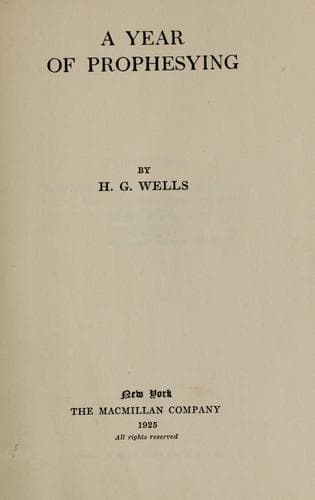
A year of prophesyingWells, H. G. (Herbert George)
History
A year of prophesying
Wells, H. G. (Herbert George)
Civilization, Modern -- 20th century; Europe -- History -- 20th century; Great Britain -- History -- 20th century
Let us state the case briefly and simply. Nobody who knows anything
of the facts of the case regards the citizen of the United States
as a sort of transplanted Britisher; but with the exception of
certain coloured millions and certain Red Indian survivals they are
manifestly transplanted Europeans, whose political institutions were
originally built up in reaction to the Hanoverian monarchy and as a
development of and in close sympathy with European liberalism and
British nonconformity. This community of transplanted Europeans had
the good fortune to have no strong military neighbour, and it had an
almost virgin continent into which to expand. This good fortune enabled
the States to realise very swiftly the full social and political
possibilities of steamboat, railway, and electric communication.
They have developed a great State on the modern scale, with an
unprecedented unity and uniformity of general ideas. A little too
favoured by their immunities, they have not perhaps made so good a
pace as they might have done with their general elementary education,
but altogether their progress has been marvellous. The congested
and entangled States of Western Europe--I leave out the Russian and
British systems, which are neither of them truly European--are destined
to achieve an ultimate unity under the same irresistible forces of
transport that have expanded and held together the American United
States. Their unification may be complicated or arrested by the
unavoidable interweaving of the Slav and British systems with their
destinies, and it is surely impossible for anyone outside the Belloc
type of mentality to imagine either English-speaking or Latin-speaking
America having neither voice nor share in the European part of this
recrystallisation of the world’s affairs.
In this new order of life into which our kind is passing, Roman
Christendom will become a local tradition and a province, just as
Sumeria was swallowed up in Babylonia and just as the Empires of
Babylon and Egypt became memories and provinces in the Empire of Rome.
We are not developing new races, but merely mingling those we have, and
our cultures do not so much differentiate as fuse, so we may reasonably
hope to have at last one creative culture, with many aspects, replacing
the partial civilisations of the past.
Fate has imposed it upon Mr. Belloc that he should see these things
and deny them. His lot, I think, might have been happier had he been
born and settled in some rich little town in the South of France, and
there sat in the café, drinking his good red wine and orating and
denying, without the irritation of having seen and known. But it was
decreed that he should go to America and come back to report a strange
and terrible land where the mountains are not really mountains nor the
rivers rivers, and where a strange race grows outside the pale.
Public-domain text, read in full here on John Shaqi.
Reviews
Reviews
No reviews yet
Be the first to share your thoughts on this work.
Elsewhere in the archive
Join the Discussion
Join the discussion
Sign in to leave a comment or review.
Sign InorCreate an account