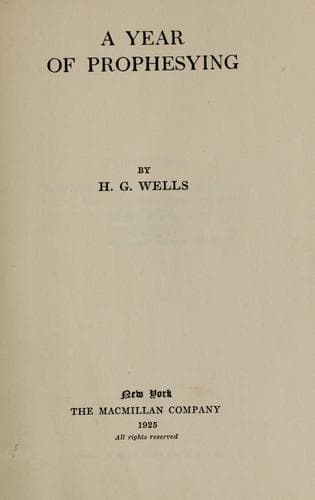
A year of prophesyingWells, H. G. (Herbert George)
History
A year of prophesying
Wells, H. G. (Herbert George)
Civilization, Modern -- 20th century; Europe -- History -- 20th century; Great Britain -- History -- 20th century
But it is not only upward that the school age should extend, but also
downward. It should be possible for poor parents who cannot afford
a nursery to send their children to the people’s schools at a quite
tender age. The children of prosperous people have a governess, or in
towns go to some properly equipped infant school, by the time they are
four or five. The children of the working-class woman knock about
at home with a mother too busy to give them sufficient educational
attention, and their only open air is the street. They miss the
beginnings of drawing and modelling and such-like play; they do not get
sufficiently talked to; they get little or no music; they start with
that much handicap. Vile attempts at economy in British education have
meant a grave retrogression in this respect. The schools have to be
reopened to infants, and the facilities for infant teaching restored
and extended. The public infant school must be the day-nursery of the
poor.
Both these extensions of the school age will require more teachers. And
even as it is, the British schools are scandalously understaffed. Not
only is that so, but many of the existing staffs are under-trained and
under-educated for their work. I cannot conceive of British education
as a satisfactory system with less than quadruple the number of
teachers at work than are now employed.
Moreover they have to be better teachers. When British elementary
education was organised in the ’seventies of the last century it was
done in the shabbiest and cheapest way possible. Those were the days
when Englishwomen of the prosperous classes would become half frantic
with jealousy and hate and derision at the idea of a housemaid wearing
a fringe or the cook going out in pretty clothes on a Sunday. That was
the spirit of the time. It was intolerable to them that the poor man’s
“brats” should be taught by really educated persons. The prospective
teachers of the general public, therefore, were not sent through the
Universities and made a part of the general comity of educated men
and women. They were put apart into mean, bleak, restricted training
colleges of their own, and everything was done to establish and
maintain a sense of social inferiority in their minds. They were
intended to feel the superiority of the parson and the lordship of
the manufacturer and the squire. Never has a profession risen to
self-respect against such obstacles and disadvantages as the British
elementary teachers. It is for Mr. Trevelyan to complete the expansion
and liberalisation of these training colleges, to see that they get at
last the staffs, libraries, laboratories, and facilities of interchange
necessary to incorporate them completely in the university system of
the land. Or else to hand them over to the local authorities as lunatic
asylums or something of that sort or to reconstruct them to meet the
housing shortage, or just simply to dynamite them and send the whole of
Public-domain text, read in full here on John Shaqi.
Reviews
Reviews
No reviews yet
Be the first to share your thoughts on this work.
Elsewhere in the archive
Join the Discussion
Join the discussion
Sign in to leave a comment or review.
Sign InorCreate an account