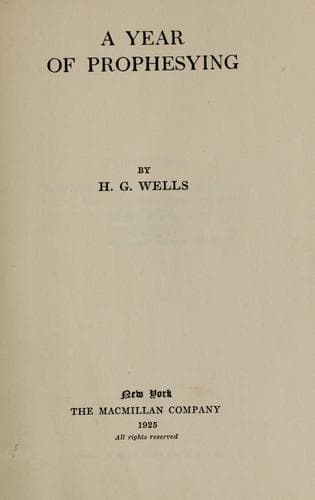
A year of prophesyingWells, H. G. (Herbert George)
History
A year of prophesying
Wells, H. G. (Herbert George)
Civilization, Modern -- 20th century; Europe -- History -- 20th century; Great Britain -- History -- 20th century
the next generation of teachers through the Universities.
Having secured an adequate supply of soundly trained and educated
teachers, and with the whole youthful population--except those
attending the many excellent private preparatory schools in
Britain--going up to the age of sixteen, at least, to the publicly
maintained schools, it will be possible for Mr. Trevelyan to give his
mind to the very urgent problem of grading schools. The organisers of
elementary education in Britain, like the American fathers, seem to
have thought that a school was just a school. But children under the
age of twelve require very different educational surroundings from
those between twelve and sixteen. The Junior school may well be a mixed
village school as close to mother as possible, a small school, bright
and homelike. The Second school needs to be larger, and with a various
staff; children are already differentiating after twelve, there must be
a choice of studies, one child’s education is another child’s poison.
Moreover, the equipment needed at the second stage is greater and more
various. Educational centres are indicated here, and the automobile to
collect the youngsters comes happily into the world at this stage to
enable both Britain and America to meet the demands of an advancing
civilisation upon rural youth.
Over most of Britain the market towns lie at eight or ten miles apart;
the roads converge upon them, they are the natural places for the
Second schools. Here is a very pretty and, I should think, a very
congenial task of reorganisation for Mr. Trevelyan. Like Edward VI of
England, it may be his destiny to write his name upon England with a
trail of new and reconstructed schools.
But an educational system that secures merely a proper education
for every British boy or girl up to the age of sixteen is only the
broad foundation of a complete State education. The English “Public
Schools,” which are not really public at all, and which retain their
boys in a state of loutish athleticism two years or more after
they should be at college; the miscellany of “upper-class” girls’
schools; the Universities, that are partly continuation colleges
and partly Universities for real intellectual work and interchange,
much incommoded by undergraduates’ “rags,” solemn athleticism, and
a pervading adolescent clamour; the antiquated and boring legal and
medical professional training; and, indeed, the whole tangle of
class-conscious, middle- and upper-class educational institutions
in Britain, would be enormously benefited, and I hope will be
benefited, by a bold--even though it were at the time an entirely
unsuccessful--attempt at reorganisation upon modern lines.
Public-domain text, read in full here on John Shaqi.
Reviews
Reviews
No reviews yet
Be the first to share your thoughts on this work.
Elsewhere in the archive
Join the Discussion
Join the discussion
Sign in to leave a comment or review.
Sign InorCreate an account