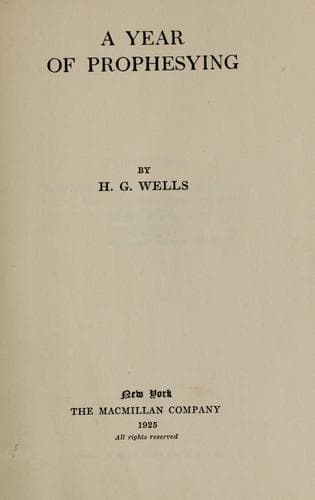
A year of prophesyingWells, H. G. (Herbert George)
History
A year of prophesying
Wells, H. G. (Herbert George)
Civilization, Modern -- 20th century; Europe -- History -- 20th century; Great Britain -- History -- 20th century
I have recently been watching British politics from a rather
interesting angle; I have been seeing Britain through Latin eyes
from the Portuguese corner of Europe. Events come to me generally in
this order. First the Lisbon _Diario des Noticias_ comes in with my
coffee; next day the French _Quotidien_ arrives before lunch and the
Italian _Secolo_ at dinner, and there is usually another twenty-four
hours before a bundle of London papers comes to hand. The Paris
_Daily Mail_ or the _Action Française_ may come in neck and neck with
the _Quotidien_, but I don’t go out of my way to see them. I get no
American papers at all. In this perspective the death of Dr. Theophilo
Braga, a sort of Frederic Harrison, who was the first President of the
Portuguese Republic, and a congress of Latin Pressmen in Lisbon take
on the importance of considerable international events, and all that
looms largest in the London _Times_ or the American Press undergoes a
compression that amounts at times to complete effacement. That stupid
outrage upon civilisation, the deportation of Miguel de Unamuno, the
great rector of the University of Salamanca, to the Canary Islands
because of his disrespect for the Spanish monarchy and dictatorship
gets a large Press in all these Latin countries. It matters to them. It
ought to matter to every civilised man. The petroleum scandals in the
United States get a rather muddled attention; every country has the oil
scandals it deserves; and there were important articles upon the death
of President Wilson. In its day the coming of the League of Nations
was a great event. Otherwise there has been very little notice either
of the United States or the overseas Empire of Britain. America means
Brazil, and “overseas” Angola.
The Latin mind has always inclined to be sceptical and cynical about
the League of Nations. Was it Anglo-Saxon practicality or Anglo-Saxon
hypocrisy behind this new thing? Did the Americans and British mean
what the League seemed to mean, or was it just another of their deep
inexplicable manœuvres? The doubts have long since carried the day. The
Paris _Quotidien_ supports the League, indeed, but it concerns itself
very little about the criticism or creative reconstruction of the
League, as it would do if it regarded the concern as a working reality.
It treats the whole business as a sort of ethical deep breathing--good
chiefly for the soul. When it refers to it, a note of piety comes into
its style.
Public-domain text, read in full here on John Shaqi.
Reviews
Reviews
No reviews yet
Be the first to share your thoughts on this work.
Elsewhere in the archive
Join the Discussion
Join the discussion
Sign in to leave a comment or review.
Sign InorCreate an account