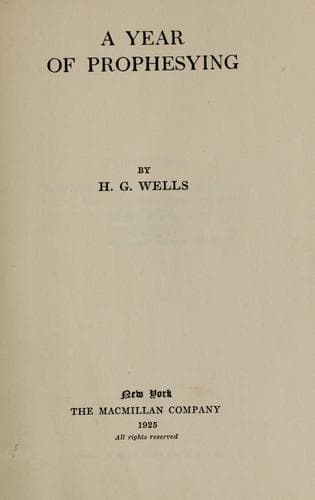
A year of prophesyingWells, H. G. (Herbert George)
History
A year of prophesying
Wells, H. G. (Herbert George)
Civilization, Modern -- 20th century; Europe -- History -- 20th century; Great Britain -- History -- 20th century
The arrival of a Labour Government in Britain was a matter for lively
attention in all these Latin lands. Liberal thinkers everywhere
welcomed it with a hopefulness that was only very faintly tainted by
suspicion. Here, perhaps, was a new thing, a break in the age-long
British tradition of heavy national selfishness and overbearing
self-righteousness. Bits of election addresses, Labour manifestos, and
so forth, had filled up columns and carried headlines in every paper
from Oporto to Fiume and from Mexico to Buenos Aires. This Labour stood
for a reconstituted League of Nations, with wider powers; it stood for
a generous treatment of Russia and Germany; it stood for disarmament;
it stood for a universal retrenchment of military and naval expenditure
and a surcease of grabbing and exploitation. Once again, just as with
the League of Nations, the Latin Press betrayed the peculiar power
which the great English-speaking community might and could exercise, of
putting over broad political ideas to the world at large. There is a
natural reciprocity between the mind of the Latin community and ours;
it is far more delicately critical and far less rudely creative. We can
do much to sustain or destroy its faith. It can do much to clarify our
ideas.
The first utterances of the new Government were scanned with
exceptional closeness; the gestures of Mr. Ramsay MacDonald were
watched with ten times the attention that was ever given to Mr.
Baldwin’s. The prompt recognition of Russia was widely approved
of; the rather empty politenesses towards M. Poincaré were taken as
evidence of an essential goodness of heart and a desire to give him
a fair chance--and then came this business of the cruisers. It would
be hard to exaggerate its evil effect. The first I saw of it was in
the Lisbon morning paper. The paragraph was headed “Signor MacDonald,
Militarist,” and the statement was made without any qualification that
the Labour Government was to lay down the keels of five new cruisers
forthwith. It seemed incredible. Followed the French and Italian
papers. The Italians were derisive at this footnote to the disarmament
conference at Rome, and the French clamoured for six cruisers in reply
to the British “challenge.” The _Quotidien_ was disappointed but not
surprised. The caricaturists, who do so much in the Latin countries to
personify the character of nations and peoples, got to work, and are
still at work, rubbing in this last revelation of the British soul. One
discerned the sensitive, the irritable Latin mind sick with disgust and
bitterly ashamed of itself for its folly in supposing for a moment that
the Labour programme was anything more than electioneering flummery.
“Labour” was just a fine name for a group of British politicians as
dishonest, as basely “patriotic,” as dangerous to the welfare of Europe
as any other group.
Public-domain text, read in full here on John Shaqi.
Reviews
Reviews
No reviews yet
Be the first to share your thoughts on this work.
Elsewhere in the archive
Join the Discussion
Join the discussion
Sign in to leave a comment or review.
Sign InorCreate an account