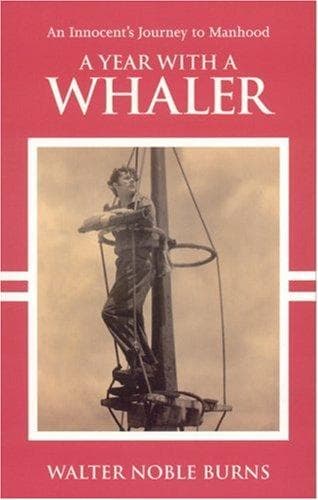
Alexander (Brig); Burns, Walter Noble, 1872-1932 -- Voyages and travels; Whalers (Persons) -- United States -- Biography; Whaling
Richard, the German, was a sturdy, manly young chap who had served in the
German navy. He was well educated and a smart seaman. Ole Oleson, the
Norwegian, was just out of his teens but a fine sailor. Peter Swenson,
a Swede, was a chubby, rosy boy of sixteen, an ignorant, reckless,
devil-may-care lad, who was looked upon as the baby of the forecastle and
humored and spoiled accordingly.
Among the six white green hands, there was a "mule skinner" from western
railway construction camps; a cowboy who believed himself fitted for
the sea after years of experience on the "hurricane deck" of a bucking
broncho; a country boy straight from the plow and with "farmer" stamped
all over him in letters of light; a man suspected of having had trouble
with the police; another who, in lazy night watches, spun frank yarns
of burglaries; and "Slim," an Irishman who said he had served with the
Royal Life Guards in the English army. There was one old whaler. He was a
shiftless, loquacious product of city slums. This was his seventh whaling
voyage--which would seem sufficient comment on his character.
"It beats hoboing," he said. And as his life's ambition seemed centered on
three meals a day and a bunk to sleep in, perhaps it did.
Two Kanakas completed the forecastle crew. These and the cabin boy, who
was also a Kanaka, talked fair English, but among themselves they always
spoke their native language. I had heard much of the liquid beauty of the
Kanaka tongue. It was a surprise to find it the most unmusical and harshly
guttural language I ever heard. It comes from the mouth in a series of
explosive grunts and gibberings. The listener is distinctly and painfully
impressed with the idea that if the nitroglycerine words were retained in
the system, they would prove dangerous to health and is fearful lest they
choke the spluttering Kanaka to death before he succeeds in biting them
off and flinging them into the atmosphere.
CHAPTER III
WHY WE DON'T DESERT
As soon as we were under sail, the crew was called aft and the watches
selected. Gabriel was to head the starboard watch and Mendez the port.
The men were ranged in line and the heads of the watches made their
selections, turn and turn about. The deep-water sailors were the first to
be chosen. The green hands were picked for their appearance of strength
and activity. I fell into the port watch.
Sea watches were now set--four hours for sleep and four for work
throughout the twenty-four. My watch was sent below. No one slept during
this first watch below, but we made up for lost time during our second
turn. Soon we became accustomed to the routine and found it as restful
as the usual landsman's method of eight hours' sleep and sixteen of
wakefulness.
Public-domain text, read in full here on John Shaqi.
Reviews
Reviews
No reviews yet
Be the first to share your thoughts on this work.
Join the Discussion
Join the discussion
Sign in to leave a comment or review.
Sign InorCreate an account