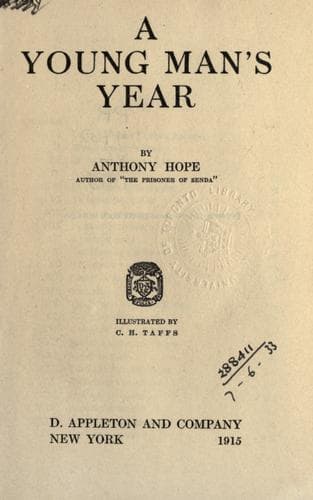
England -- Social life and customs -- Fiction; Lawyers -- Fiction; Man-woman relationships -- Fiction; Young men -- Fiction
She wanted no quarrel and was confident of her ability to prevent one.
If one came, she would have to be arbiter; she would have to take sides,
and that must almost certainly mean the loss of one of her
friends--either Sidney Barslow or Arthur Lisle. She did not want to lose
either, for each had an attraction for her--an attraction not of mere
solid friendship such as bound her to Joe Halliday, but an appeal of man
to woman. Barslow's boldness, his challenge, his powerful virility drew
one side of her nature with a strong magnet; to what was 'second-class'
and tawdry in him she was not, by birth or breeding, very sensitive
herself. On the other hand she knew that Arthur Lisle was, and admired
him because he was. Nay, in a sense she was afraid of him because he
was; if she did or said anything in his eyes amiss--if she shewed too
much favour to Sidney Barslow, for instance--he might feel about her
much as he did about the man himself. She knew all about Barslow, and
all about what Barslow felt for and about herself; it was very familiar,
one might say inherited, ground. With regard to Arthur Lisle all this
was different; he was still, in spite of their apparent intimacy, _terra
incognita_. Though he constantly frequented the house, though from a
chance acquaintance of her brother's he had grown into a familiar
friend, though they were fast comrades, even though she knew that he
admired her, there was so much about him which she vaguely divined to be
there, but could not value or analyse--notions, instincts, spots of
sensitiveness, to which she remained really a stranger. How strong were
they, what was their verdict on her, what their influence on him? Would
a tide of admiration or passion sweep them all away? Or would they make
such a tide impossible, or, even if it came, dam its course with
impalpable insurmountable obstacles? In fine, would he, in spite of any
feeling for her that he might have, hold her "out of the question"?
He was the last to leave that night--as he often was, for the solitude
of his lodgings had no attraction for him--and she went with him to the
door. The stars shone now over Regent's Park, and they lingered a moment
in astronomical conversation. Then she gave him her hand, saying:
"I'm so sorry about Monday. But you must tell me all about your party
afterwards!"
"I don't suppose there'll be anything to tell. Well, Mildred Quain may
be interested, because of her uncle!"
"I shall be interested too--though not because of my uncle," she said
with a laugh and a fleet upward glance at him. "I consider I've
introduced you to London society, and I take a maternal interest in you,
Mr. Lisle."
"Why do you say 'Mr. Lisle' to me? You always say 'Joe' and 'Sidney' to
the others."
"So I do. I don't know!"
"Well, then, don't do it," laughed Arthur. "It makes me jealous, you
know."
She looked at him for a moment, not now in provocation, rather in
thought, perhaps in puzzle. "It needn't do that, anyhow," at last she
said.
Public-domain text, read in full here on John Shaqi.
Reviews
Reviews
No reviews yet
Be the first to share your thoughts on this work.
Join the Discussion
Join the discussion
Sign in to leave a comment or review.
Sign InorCreate an account