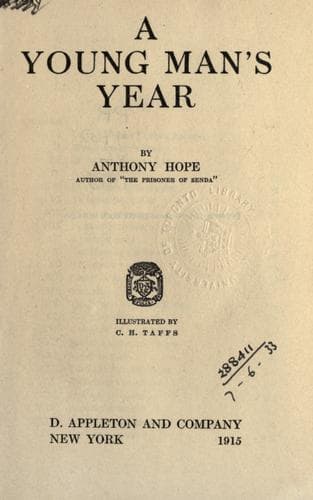
England -- Social life and customs -- Fiction; Lawyers -- Fiction; Man-woman relationships -- Fiction; Young men -- Fiction
"I--I've never been there," Arthur stammered. He was blushing very red.
Here he was, up against this terrible business of the Godfrey Lisles
again--and just as he had begun to get along so nicely!
His confusion, nay, his distress, could not escape the Judge. "I hope I
haven't made a _faux pas_, Mr. Lisle? No quarrel, or anything of that
sort, I hope?"
"No, sir, but I don't know them. I haven't called yet," Arthur blurted
out; he seemed to himself to be always having to blurt it out.
Sir Christopher's eyes twinkled, as, following the host's example, he
rose from the table.
"If I were you, I should. You don't know what you're missing."
Upstairs Mrs. Norton Ward was better than Arthur's hopes. She showed him
at once that she meant to talk to him and that she expected to like
doing it.
"I'm always friends with everybody in Frank's chambers," she said, as
she made him sit by her. "I consider them all part of the family, and
all the glory they win belongs to the family; so you must make haste and
win glory, if you can, for us!"
"I'm afraid I can't win glory," laughed Arthur. "At least it doesn't
look like it--at the Bar."
"Oh, win it anyhow--we're not particular how--law, politics, literature,
what you like! Why, Milton Longworth was Frank's pupil once--for a
month! He did no work and got tipsy, but he's a great poet now--well,
isn't he?--and we're just as proud as if he'd become Attorney-General."
"Or--well--at all events, a County Court Judge!" Arthur suggested.
"So just you do it somehow, Mr. Lisle, won't you?"
"I'll try," he promised, laughing. "The other day I heard of you in your
glory. You sounded very splendid," he added.
Then he had to tell her all about how he had heard, about Mildred Quain,
and so about the rest of the circle in Regent's Park. His shyness
vanished; he gave humorous little sketches of his friends. Of course she
knew Sarradet's shop, and was amused at this lifting of the veil which
had hidden the Sarradet private life. But being the entirely natural
creature she was, talking and thinking just as one of her class
naturally would, she could not help treating the Sarradets as something
out of her ordinary experience, as something rather funny--perhaps also
instructive--to hear about, as social phenomena to be observed and
studied. Without her own volition or consciousness her mind naturally
assumed this attitude and expressed it in her questions and comments;
neither were cruel, neither malicious, but both were absolutely from the
outside--comments and questions about a foreign country addressed to a
traveller who happened to have paid a visit there; for plainly she
assumed, again instinctively, that Arthur Lisle was no more a native of
that country than herself. Or he might almost have been an author
presenting to an alert and sympathetic reader a realistic and vivacious
picture of the life of a social class not his own, be it what is called
higher or lower, or just quite different.
Public-domain text, read in full here on John Shaqi.
Reviews
Reviews
No reviews yet
Be the first to share your thoughts on this work.
Join the Discussion
Join the discussion
Sign in to leave a comment or review.
Sign InorCreate an account