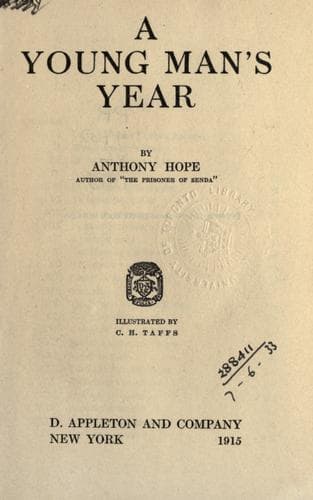
England -- Social life and customs -- Fiction; Lawyers -- Fiction; Man-woman relationships -- Fiction; Young men -- Fiction
She flushed hotly; tears came in her eyes. He saw what he had done, and
was touched to a sudden remorse.
"Oh, I say, Marie, I didn't mean----!"
"I shan't forget that," she said. "Never!"
He shrugged his shoulders and stuck his pipe back in his mouth. He was
ashamed, but obstinate still. "You brought it on yourself," he grumbled.
"Yes, I forgot that I wasn't talking to a gentleman."
He made one more effort after reconciliation. "Look here, Marie, you
know what I think of you----"
"Yes, I do--you've just told me."
"Damnation!" he muttered, pulling at his pipe. Marie, looking carefully
past him, began to put on her gloves. Thus Amabel and Raymond found
them--with things obviously very wrong. Amabel diagnosed an offer and a
refusal, but Raymond thought there must be even more behind his sister's
stormy brow and clouded eyes. The journey back was not cheerful.
Marie was indeed cut to the quick. Even to herself it was strange how
deeply she was wounded. The Sarradets had never been ashamed of the
shop; rather they had taken an honourable pride in it and in the growth
of its fortunes from generation to generation. Yet Sidney Barslow's gibe
about the counter was to her now unforgivable. It brought into coarse
and vivid relief her secret doubts and fears. It made her ask whether
she, having made a friend of the man who had used a taunt like that,
must not have something about her to justify it. It set her on fire to
put an utter end to her friendship and association with Sidney
Barslow--and thereby to prove to herself that, whatever her manners
might be they were at least too good for such company as his.
Hitherto pretty equally balanced between the two young men, or at all
events wistfully anxious that friendship with Arthur should not make
impossible her old and pleasant comradeship with Sidney--in whom she
found so much that she liked--she became now Arthur's furious partisan.
With him and his cause she identified herself. She declared that it was
purely for his sake, and not at all in the interest of her own
domination and authority, that she had rebuked Sidney, and for his sake
solely that she had suffered insult. By a natural turn of feeling she
asked in her heart for a reward from him, a recognition of her
championship, gratitude to her for having preferred him to his would-be
rival; if he were not at least a little pleased and proud, she would
feel disappointment and humiliation.
Public-domain text, read in full here on John Shaqi.
Reviews
Reviews
No reviews yet
Be the first to share your thoughts on this work.
Join the Discussion
Join the discussion
Sign in to leave a comment or review.
Sign InorCreate an account