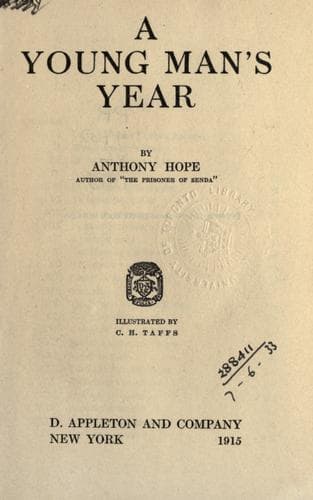
England -- Social life and customs -- Fiction; Lawyers -- Fiction; Man-woman relationships -- Fiction; Young men -- Fiction
His invitation to dinner really pleased Arthur very much, not only as a
sign of friendship, but for its own sake. He had found his early days in
London lonely--in depressing contrast with the full social life of
school and Oxford. The glowing anticipations with which imagination had
invested his coming to the metropolis had not stood the test of
experience. For some young men family connections, or notable
achievements and high reputation, provide a ready-made place in London.
Others possessed of ample means can make a pretty good one for
themselves speedily. But Arthur's university career, though creditable
and to him delightful in the highest degree from its teeming fulness of
interests, had not been conspicuous; he had no powerful friends, and he
was very poor. After his chambers were paid for, and his share in Henry,
and his lodgings in Bloomsbury Street, there was left not much margin
beyond the necessities of life--food, raiment, and tobacco. The theatre,
even the pit, could not be indulged in often. He had many solitary
evenings. When it was fine, he often walked the streets; when it was wet
he read--and often stopped reading to wish that something would happen.
His vague and restless longings took no form more definite than
that--wanting something to happen. He was in London, he was young, he
was ready--and nothing happened! Consequently an invitation to dinner
was a prize in the daily lottery of life.
When he got back to his 'diggings' in the evening, he found a letter
from home. His mother and sister had continued to live on in the old
house at Malvern Wells after the death of his father, who had enjoyed a
fairly good practice as a doctor there, but dying comparatively early
had left a slender provision for his family. Mrs. Lisle preferred to be
poor, since poor she had to be, in a place where she was already known
and respected. The school too was a great attraction; there Arthur had
been educated as a day boy, and thence had proceeded to Oxford with an
exhibition, to which he added a second from his college, thus much
easing the family finances, and indeed rendering Oxford possible. There
had been talk of his people's migrating to London and making a home for
him there, but in fact none of the three had been zealous for the
change. Mrs. Lisle was frail and clung to her accustomed hills and
breezes; Anna had her friends, her circle, her church work, her local
importance; and Arthur was at that time too full of those glowing
anticipations of London life to press the project of a family villa
somewhere in the suburbs and a season-ticket to take him out of town at
the precise hour of the evening when town began to be amusing.
For all that, he was an affectionate son and brother, and he smiled
sympathetically over Anna's home gossip. Only the postscript made him
frown rather peevishly. It ran: "Mother wants to know whether you have
called on the Godfrey Lisles _yet_!"
Public-domain text, read in full here on John Shaqi.
Reviews
Reviews
No reviews yet
Be the first to share your thoughts on this work.
Join the Discussion
Join the discussion
Sign in to leave a comment or review.
Sign InorCreate an account