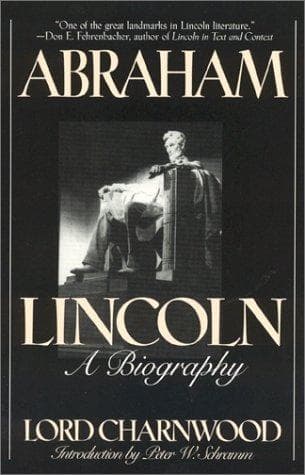
Abraham LincolnCharnwood, Godfrey Rathbone Benson, Baron
History
Abraham Lincoln
Charnwood, Godfrey Rathbone Benson, Baron
Lincoln, Abraham, 1809-1865; Presidents -- United States -- Biography
Produced by Al Haines
ABRAHAM LINCOLN
BY LORD CHARNWOOD
GARDEN CITY, NEW YORK
GARDEN CITY PUBLISHING CO., INC.
COPYRIGHT, 1917
BY
HENRY HOLT AND COMPANY
GENERAL EDITOR'S PREFACE
Statesmen--even the greatest--have rarely won the same unquestioning
recognition that falls to the great warriors or those supreme in
science, art or literature. Not in their own lifetime and hardly to
this day have the claims to supremacy of our own Oliver Cromwell,
William III. and Lord Chatham rested on so sure a foundation as those
of a Marlborough or a Nelson, a Newton, a Milton or a Hogarth. This is
only natural. A warrior, a man of science, an artist or a poet are
judged in the main by definite achievements, by the victories they have
won over foreign enemies or over ignorance and prejudice, by the joy
and enlightenment they have brought to the consciousness of their own
and succeeding generations. For the statesman there is no such exact
measure of greatness. The greater he is, the less likely is his work
to be marked by decisive achievement which can be recalled by
anniversaries or signalised by some outstanding event: the chief work
of a great statesman rests in a gradual change of direction given to
the policy of his people, still more in a change of the spirit within
them. Again, the statesman must work with a rough and ready
instrument. The soldier finds or makes his army ready to yield
unhesitating obedience to his commands, the sailor animates his fleet
with his own personal touch, and the great man in art, literature or
science is master of his material, if he can master himself. The
statesman cannot mould a heterogeneous people, as the men of a
well-disciplined army or navy can be moulded, to respond to his call
and his alone. He has to do all his work in a society of which a large
part cannot see his object and another large part, as far as they do
see it, oppose it. Hence his work at the best is often incomplete and
he has to be satisfied with a rough average rather than with his ideal.
Lincoln, one of the few supreme statesmen of the last three centuries,
was no exception to this rule. He was misunderstood and underrated in
his lifetime, and even yet has hardly come to his own. For his place
is among the great men of the earth. To them he belongs by right of
his immense power of hard work, his unfaltering pursuit of what seemed
to him right, and above all by that childlike directness and simplicity
of vision which none but the greatest carry beyond their earliest
years. It is fit that the first considered attempt by an Englishman to
give a picture of Lincoln, the great hero of America's struggle for the
noblest cause, should come at a time when we in England are passing
through as fiery a trial for a cause we feel to be as noble. It is a
time when we may learn much from Lincoln's failures and success, from
his patience, his modesty, his serene optimism and his eloquence, so
simple and so magnificent.
Public-domain text, read in full here on John Shaqi.
Reviews
Reviews
No reviews yet
Be the first to share your thoughts on this work.
Join the Discussion
Join the discussion
Sign in to leave a comment or review.
Sign InorCreate an account