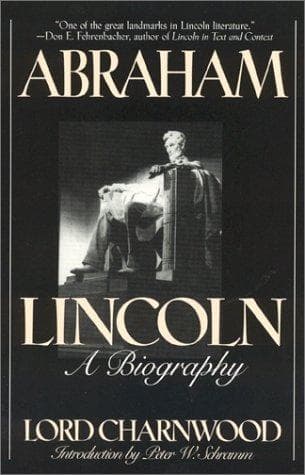
Abraham LincolnCharnwood, Godfrey Rathbone Benson, Baron
History
Abraham Lincoln
Charnwood, Godfrey Rathbone Benson, Baron
Lincoln, Abraham, 1809-1865; Presidents -- United States -- Biography
But notions of freedom and equality as applied to the negroes presented
a real difficulty. "There is," said Lincoln, "a natural disgust in the
minds of nearly all white people at the idea of an indiscriminate
amalgamation of the white and black men." (We might perhaps add that
as the inferior race becomes educated and rises in status it is likely
itself to share the same disgust.) Lincoln himself disliked the
thought of intermarriage between the races. He by no means took it for
granted that equality in political power must necessarily and properly
follow upon emancipation. Schemes for colonial settlement of the
negroes in Africa, or for gradual emancipation accompanied by
educational measures, appealed to his sympathy. It was not given him
to take a part in the settlement after the war, and it is impossible to
guess what he would have achieved as a constructive statesman; but it
is certain that he would have proceeded with caution and with the
patience of sure faith; and he had that human sympathy with the white
people of the South, and no less with the slaves themselves, which
taught him the difficulty of the problem. But difficult as the problem
was, one solution was certainly wrong, and that was the permanent
acquiescence in slavery. If we may judge from reiteration in his
speeches, no sophism angered him quite so much as the very popular
sophism which defended slavery by presenting a literal equality as the
real alternative to it. "I protest against the counterfeit logic which
says that since I do not want a negro woman for my slave I must
necessarily want her for my wife. I may want her for neither. I may
simply let her alone. In some respects she is certainly not my equal.
But in her natural right to eat the bread which she has earned by the
sweat of her brow, she is my equal and the equal of any man."
The men who had made the Union had, as Lincoln contended, and in regard
to most of them contended justly, been true to principle in their
dealing with slavery. "They yielded to slavery," he insists, "what the
necessity of the case required, and they yielded nothing more." It
was, as we know, impossible for them in federating America, however
much they might hope to inspire the new nation with just ideas, to take
the power of legislating as to slavery within each existing State out
of the hands of that State. Such power as they actually possessed of
striking at slavery they used, as we have seen and as Lincoln recounted
in detail, with all promptitude and almost to its fullest extent. They
reasonably believed, though wrongly, that the natural tendency of
opinion throughout the now freed Colonies with principles of freedom in
the air would work steadily towards emancipation. "The fathers,"
Lincoln could fairly say, "place slavery, where the public mind could
rest in the belief that it was in the course of ultimate extinction."
The task for statesmen now was "to put slavery back where the fathers
placed it."
Public-domain text, read in full here on John Shaqi.
Reviews
Reviews
No reviews yet
Be the first to share your thoughts on this work.
Elsewhere in the archive
Join the Discussion
Join the discussion
Sign in to leave a comment or review.
Sign InorCreate an account