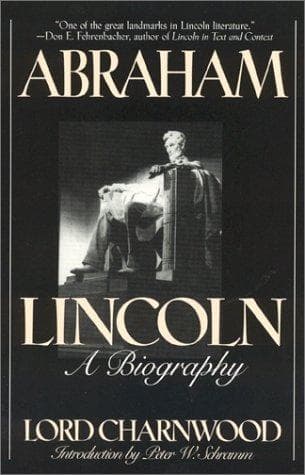
Abraham LincolnCharnwood, Godfrey Rathbone Benson, Baron
History
Abraham Lincoln
Charnwood, Godfrey Rathbone Benson, Baron
Lincoln, Abraham, 1809-1865; Presidents -- United States -- Biography
For the extinction of slavery he would wait; for a decision on the
principle of slavery he would not. It was idle to protest against
agitation of the question. If politicians would be silent that would
not get rid of "this same mighty deep-seated power that somehow
operates on the minds of men, exciting them and stirring them up in
every avenue of society--in politics, in religion, in literature, in
morals, in all the manifold relations of life." The stand, temperate
as it was, that he advocated against slavery should be taken at once
and finally. The difference, of which people grown accustomed to
slavery among their neighbours thought little, between letting it be in
Missouri, which they could not help, and letting it cross the border
into Kansas, which they could help, appeared to Lincoln the whole
tremendous gulf between right and wrong, between a wise people's
patience with ills they could not cure and a profligate people's
acceptance of evil as their good. And here there was a distinction
between Lincoln and many Republicans, which again may seem subtle, but
which was really far wider than that which separated him from the
Abolitionists. Slavery must be stopped from spreading into Kansas not
because, as it turned out, the immigrants into Kansas mostly did not
want it, but because it was wrong, and the United States, where they
were free to act, would not have it. The greatest evil in the repeal
of the Missouri Compromise was the laxity of public tone which had made
it possible. "Little by little, but steadily as man's march to the
grave, we have been giving up the old faith for the new faith."
Formerly some deference to the "central idea" of equality was general
and in some sort of abstract sense slavery was admitted to be wrong.
Now it was boldly claimed by the South that "slavery in the abstract
was right." All the most powerful influences in the country, "Mammon"
(for "the slave property is worth a billion dollars"), "fashion,
philosophy," and even "the theology of the day," were enlisted in
favour of this opinion. And it met with no resistance. "You yourself
may detest slavery; but your neighbour has five or six slaves, and he
is an excellent neighbour, or your son has married his daughter, and
they beg you to help save their property, and you vote against your
interests and principle to oblige a neighbour, hoping your vote will be
on the losing side." And again "the party lash and the fear of
ridicule will overawe justice and liberty; for it is a singular fact,
but none the less a fact and well known by the most common experience,
that men will do things under the terror of the party lash that they
would not on any account or for any consideration do otherwise; while
men, who will march up to the mouth of a loaded cannon without
shrinking, will run from the terrible name of 'Abolitionist,' even when
pronounced by a worthless creature whom they with good reason despise."
Public-domain text, read in full here on John Shaqi.
Reviews
Reviews
No reviews yet
Be the first to share your thoughts on this work.
Elsewhere in the archive
Join the Discussion
Join the discussion
Sign in to leave a comment or review.
Sign InorCreate an account